
Insights
Technical writing on the disciplines behind wide-area counter-UAS defense — passive sensing, distributed fusion and edge learning, swarm coordination, and the threat landscape — grounded in the open academic literature and public record. Every article states its sources; none contains Aerodyne technical data.
Passive Sensing & Detection
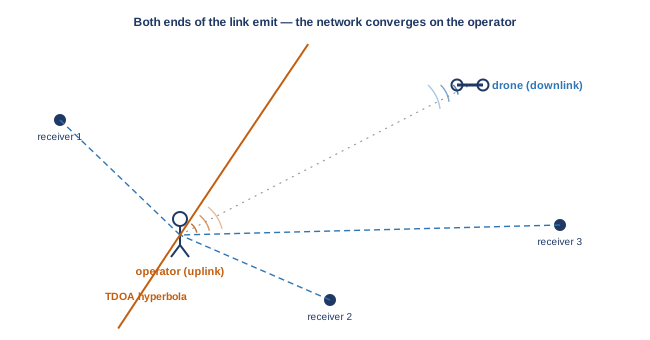
Detecting the Operator, Not Just the Aircraft: Emitter Geolocation in the Open Literature
Whenever a radio link exists, it points home in both directions. AOA, TDOA, and FDOA against the ground emitter — the textbook techniques, the practical hard parts, and why the threat evolved to stop emitting.
Threat Analysis
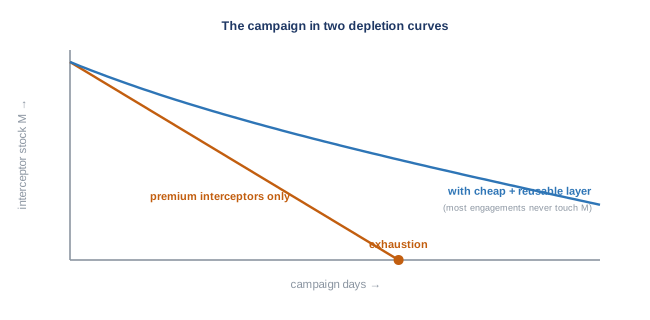
Magazine Depth as the Decisive Metric: The Arithmetic That Ends Air-Defense Campaigns
D = M/λk: stock, engagement rate, expenditure per kill — and the sustainability inequality that moves the contest to the factory floor. From the V-1 to the Red Sea, with five ways to deepen a magazine.
Programs & Policy
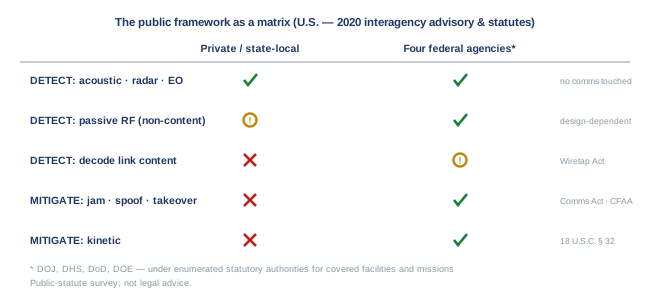
Detection at Home: The U.S. Legal Framework for Civilian Drone Detection
How a sensor detects determines whether it is lawful: the 2020 interagency advisory, the Wiretap Act's reach, why acoustic–radar–optical sensing carries the cleanest posture, and why private mitigation is closed.
Autonomy & Swarm Coordination
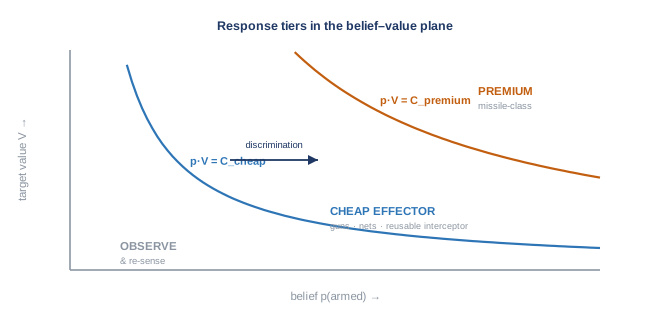
Decoy Discrimination as a Pricing Problem: Game Theory Against Saturation-by-Cheapness
A decoy weaponizes the defender's own decision rule. The engagement threshold p·V > C, signaling games and bluffing, sensors as repricing instruments, and why response ladders beat classifiers alone.
Autonomy & Swarm Coordination
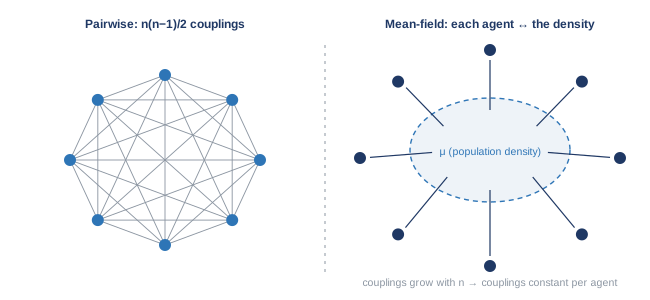
Mean-Field and Aggregate Methods: Planning for Hundreds Without Simulating Each One
Joint planning grows exponentially with fleet size. The mean-field escape — plan over the density, not the individuals — from Lasry–Lions to mean-field RL, and where the approximation honestly ends.
Threat Analysis
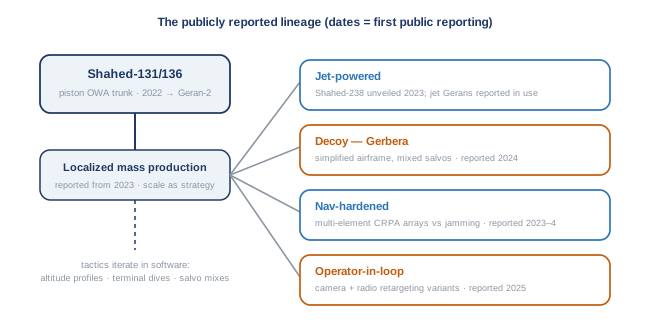
The One-Way Attack Drone Family Tree: Reading an Evolving Lineage From the Public Record
Shahed is a lineage, not an aircraft: jet variants, Gerbera decoys, hardened navigation, operator-in-the-loop retargeting — each branch answering the defender's cheapest countermeasure first.
Fusion & Distributed Intelligence
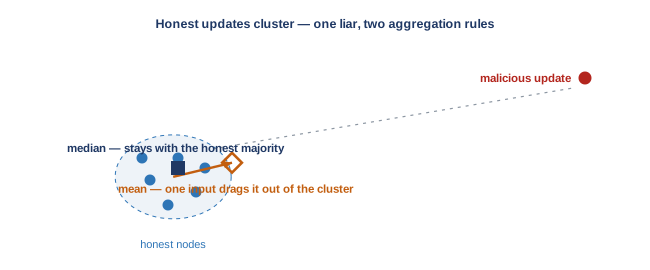
Fighting With a Compromised Network: Byzantine Resilience in Learning and Fusion
Assume some nodes will lie. Forty years of theory — from the Byzantine generals to robust federated aggregation — on how a collective computation survives capture, and what redundancy it costs.
Fusion & Distributed Intelligence
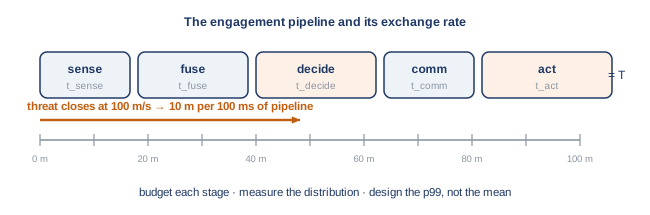
Latency Budgets in Engagement Chains: Lessons From Microsecond Infrastructure
A threat at 100 m/s converts every 100 ms of pipeline into 10 meters. What two decades of low-latency trading engineering teach about budgets, tail latency, and surviving load spikes built as weapons.
Autonomy & Swarm Coordination
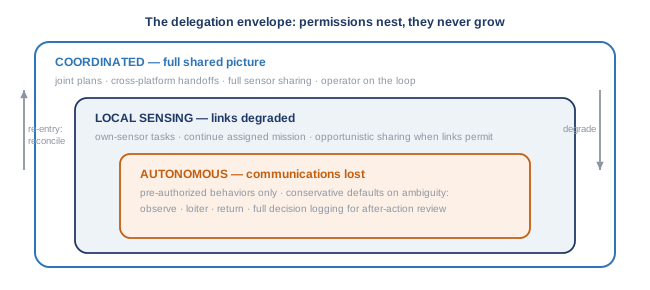
Delegated Autonomy: Bounding What a Platform May Do When the Link Is Gone
Comms loss is a schedule, not a contingency. The delegation envelope — nested permissions, plan-centrally-execute-alone, conservative defaults, and DoD Directive 3000.09 read as an engineering spec.
Programs & Policy
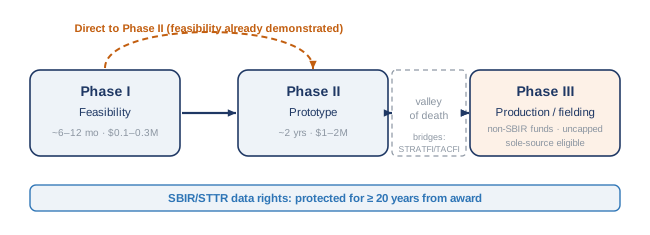
How SBIR/STTR Actually Transitions Technology: Phase I to Phase III, From the Public Record
The set-aside, the three phases, Direct to Phase II, the 20-year data-rights clock, and the sole-source Phase III lane — the machinery that turns feasibility studies into procurable products.
Programs & Policy
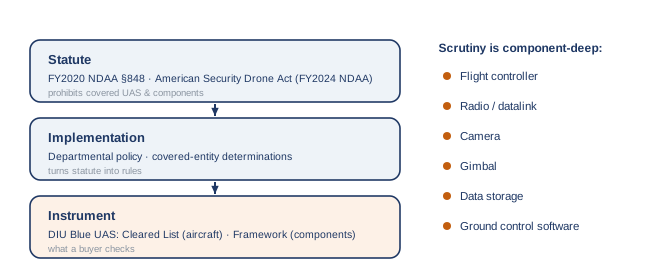
NDAA Compliance and Blue UAS: What “Compliant” Means and Why Allies Care
From FY2020 NDAA §848 and the American Security Drone Act to the DIU Blue UAS lists: what the rules prohibit, component by component, and why supply-chain origin is a day-one design decision.
Programs & Policy
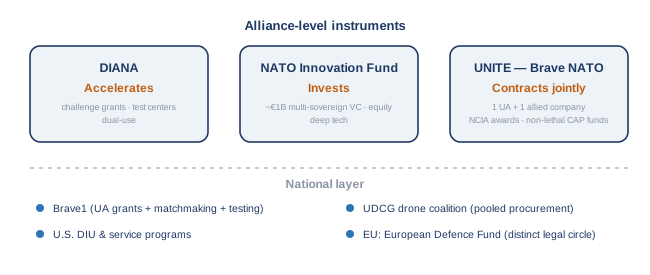
Allied Co-Development Mechanisms: The NATO Innovation Programs, From the Public Record
DIANA accelerates, the NATO Innovation Fund invests, UNITE — Brave NATO contracts joint Ukrainian-allied teams — the standing machinery for cross-border defense innovation, and how to read it as a company.
Fusion & Distributed Intelligence
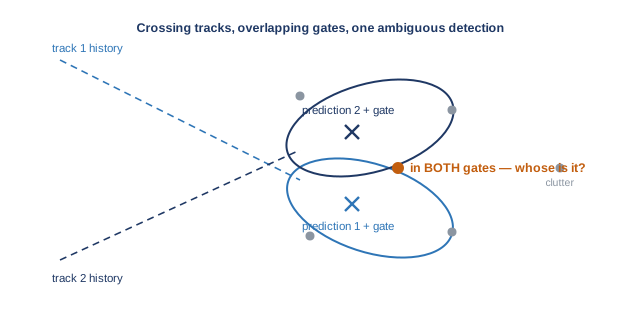
Data Association in Dense Raids: GNN, JPDA, and MHT on Their Own Terms
Before a tracker can track, it must decide which detection belongs to which aircraft. The three classical answers — decide hard, hedge, or defer — and what each costs when the raid gets dense.
Fusion & Distributed Intelligence
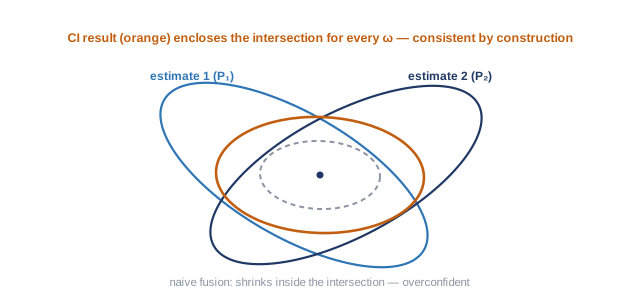
Consistency Over Optimality: Covariance Intersection and Honest Uncertainty
Fuse two correlated estimates the textbook way and your network becomes confidently wrong. The fusion rule that guarantees honesty under unknown correlations — and what it costs.
Threat Analysis
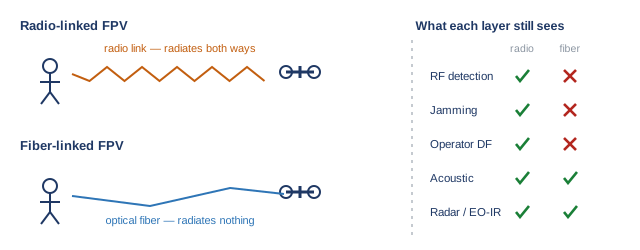
The Fiber-Optic FPV: What a Jam-Proof Control Link Changes, Layer by Layer
A spool of glass made RF detection, jamming, and operator-hunting irrelevant for one threat class. The honest ledger of what it defeats, what physics still collects, and the systems lesson.
Passive Sensing & Detection
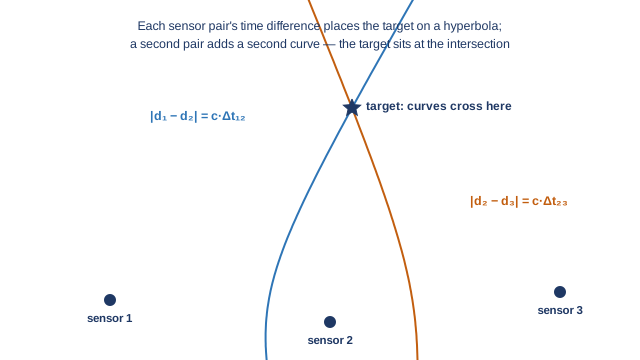
Multilateration Fundamentals: From Bearings and Time Differences to Tracks
How networks of silent sensors turn hyperbolas, bearings, and clock discipline into positions and tracks — and why geometry (GDOP) is half the accuracy budget.
Passive Sensing & Detection
Illuminators of Opportunity: Passive Radar's Geometry, Gifts, and Blind Spots
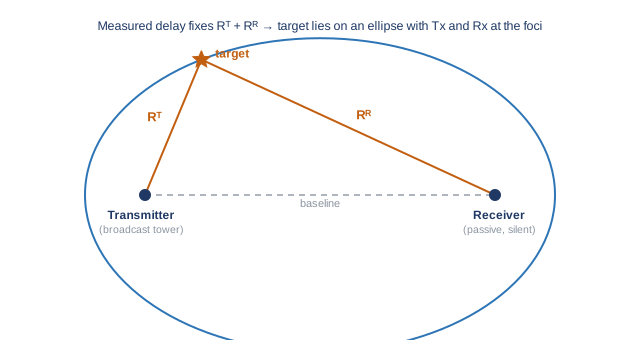
Radar without a transmitter: how FM and TV broadcasts become detection systems, why coverage follows the ovals of Cassini, and where the geometry itself writes blind spots into the map.
Passive Sensing & Detection
Acoustic Signatures of Small Aircraft: What Propulsion Physics Gives Away
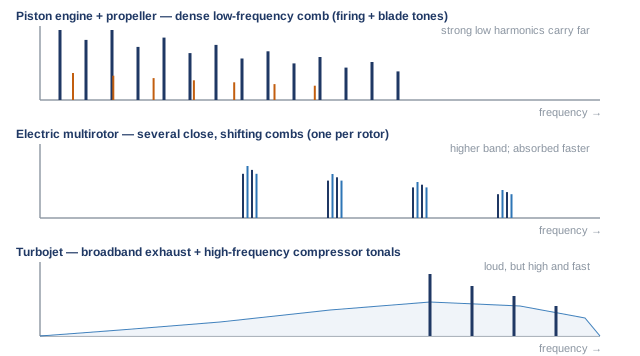
Piston, turbojet, and electric propulsion each write a distinct fingerprint into the frequency domain. What the aeroacoustics literature says about detecting — and classifying — aircraft by sound alone.
Passive Sensing & Detection
Detecting the Drone That Doesn't Transmit
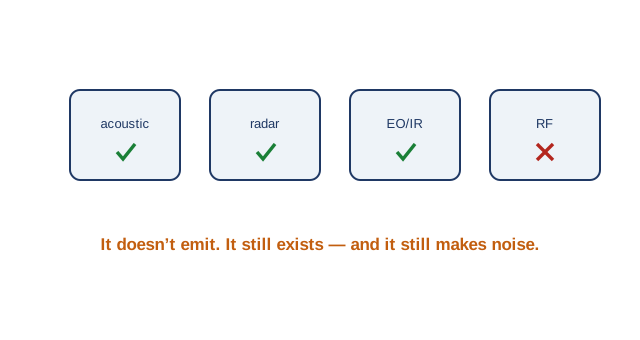
Fiber-optic FPVs and pre-programmed one-way attack drones defeat RF-scanning detection. A survey of what the open literature says about acoustic, passive-radar, and multi-modal alternatives.
Fusion & Distributed Intelligence
Track Fusion When the Network Is the Bottleneck
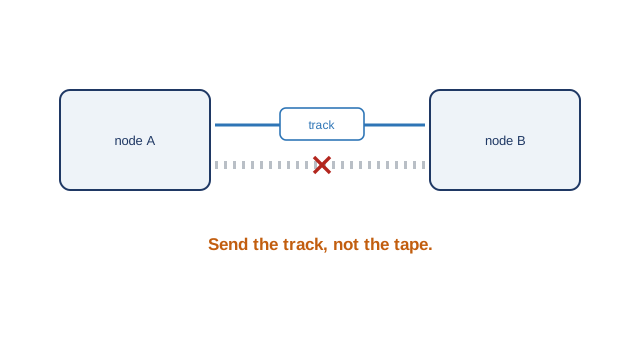
Centralized fusion is optimal and fragile. What the distributed-estimation and federated-learning literature says about building sensor networks that degrade instead of collapsing.
Autonomy & Swarm Coordination
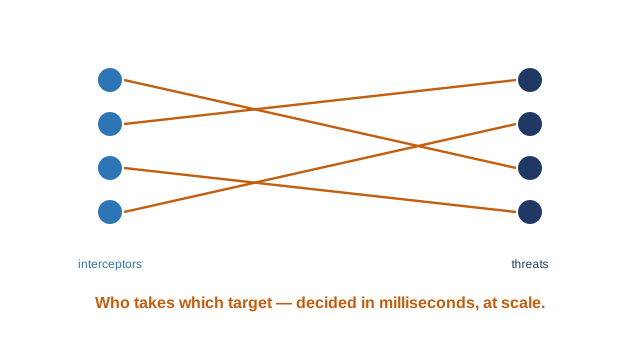
Swarm-on-Swarm Defense Is an Assignment Problem
From the Hungarian algorithm to consensus-based auctions and Dec-POMDPs: sixty years of operations research on who should engage what — and why leakers are a mathematical outcome.
Threat Analysis
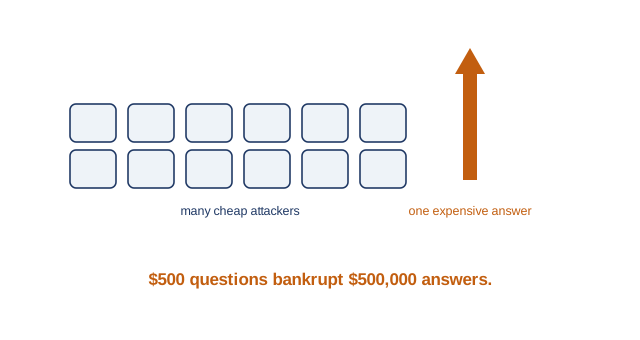
The Economics of Saturation: Why Point Defense Loses to Mass
When the munition costs a fraction of the interceptor, every intercept can be a losing trade. What the public record of drone-industrial warfare implies for defense architecture.
Articles in this category are forthcoming.