
Insights · Passive Sensing & Detection
Acoustic Signatures of Small Aircraft: What Propulsion Physics Gives Away
Every powered aircraft announces its propulsion class in the frequency domain. A piston engine, a turbojet, and an electric multirotor each write a physically distinct pattern into the air — combs of tones whose spacing is set by firing rates, shaft speeds, and blade counts, as mechanically determined as the teeth on a gear. For a defender this means acoustics is not merely a detection channel but a classification channel: the spectrum says not only "something is flying" but, with useful confidence, "what kind of thing."
Where the sound comes from: the comb and the hiss
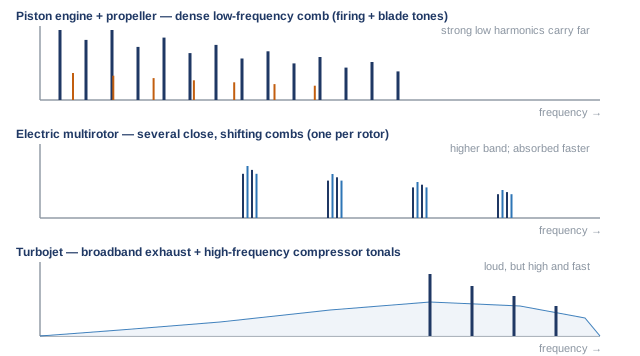
The acoustics of rotating machinery has been a mature science since the foundational work on sound generated by moving surfaces [1], and the flight-vehicle case is comprehensively surveyed in the NASA reference literature [2]. For our purposes, every aircraft sound splits into two parts. Tonal noise is the pitched part: energy concentrated at exact frequencies locked to mechanical rates — each engine firing, each blade sweeping past — and at their integer multiples, the harmonics. Plotted as a spectrum, these tones form a comb: a row of evenly spaced spectral lines, as regular as a barcode. Broadband noise is the unpitched hiss of turbulent air, smeared across all frequencies with no line structure. The comb is the fingerprint. Its line spacing tells you the machinery's rate; its overall pattern tells you the machinery's kind — because the spacing follows directly from geometry. A four-stroke piston engine fires each cylinder once per two revolutions, so its fundamental tone sits at RPM × cylinders ÷ 120 in hertz; a propeller or rotor stamps the air once per blade passage, putting its fundamental at RPM ÷ 60 × blade count. Different machines cannot help but produce different barcodes.
Piston engines: the loud, low, far-carrying case
The piston-engined one-way attack drones used at scale since 2022 are the acoustically generous case, for two compounding reasons. First, their comb is dense and low: a small engine turning a few thousand RPM with a handful of cylinders puts its fundamental well below a hundred hertz, with a strong ladder of harmonics above it and propeller tones interleaved. Second — and this is the physics that matters most — the atmosphere is a low-pass filter: air absorbs high frequencies far more aggressively than low ones. It is why nearby lightning is a sharp crack but distant lightning is only a rumble — the treble dies along the way and the bass survives. An aircraft whose acoustic energy sits in the bass is therefore audible at ranges where a higher-pitched machine has faded entirely. The consequence is a matter of public record: these drones are so audible that their nickname in reporting from Ukraine — the "moped" — is itself an acoustic description. Against this class, published academic work on microphone-array detection of small aircraft [3] operates in its most favorable regime: strong, stable, low-frequency lines are exactly what harmonic line-tracking detectors were invented for.
Electric multirotors: a chord that keeps retuning
An electric multirotor's dominant tones sit at each rotor's blade-passage frequency and harmonics — and here the aircraft's own control system becomes part of its signature. A multirotor steers by continuously speeding some rotors and slowing others, so its spectrum is not one comb but several, closely spaced and perpetually sliding against one another: a chord slightly out of tune, retuned many times a second. That restlessness is itself a classification cue — no single-engine aircraft produces it. But the physics collects a price on range. The energy sits roughly ten times higher in frequency than a piston comb, exactly where atmospheric absorption bites hardest and where wind noise in the microphones is most masking; and small electric aircraft are simply quieter to begin with. The literature is accordingly candid that detection ranges for small electric platforms are a fraction of those for combustion aircraft, and strongly weather-dependent. The design consequence is spatial rather than instrumental: against quiet electric threats, useful acoustic coverage comes from sensor density — many inexpensive nodes with overlapping short-range footprints — not from any single exquisite microphone straining at its physical limits.
Turbojets: a different barcode, a shorter clock
The turbojet variants of the one-way attack family trade the piston engine's bass drone for something spectrally opposite: broadband exhaust roar plus compressor whine — tonals tied to shaft rates ten times faster and blade counts ten times higher, pushing the line structure into the kilohertz range. The aircraft is not quiet, and the spectral difference between a piston barcode and a turbojet's is anything but subtle; classification remains firmly available. The defender's problem is time, not audibility: at two to three times the piston variants' cruise speed (figures from public reporting), the interval between first acoustic detection and arrival shrinks proportionally, and higher-frequency energy fades sooner with distance. Acoustics still contributes detection and — critically — the class call, but the engagement timeline it buys is shorter: an argument, again, for fusing the acoustic layer with sensors whose reach does not depend on how loud the target deigns to be.
What motion adds: the passing siren, made quantitative
Everyone knows the Doppler effect from a passing siren — pitch raised on approach, dropped on departure. For a tonal aircraft the same physics is a measurement: each comb line arrives shifted in proportion to the target's velocity toward the sensor, and the shape of the shift over time — the long approach plateau, the slide through closest approach, the receding plateau — encodes the aircraft's speed and how near it passed. Tracking harmonic lines through their Doppler trajectories is a technique with deep roots in passive sonar, migrated to the air; it extracts kinematics from a single microphone position. Arrays add direction, via time-difference-of-arrival and beamforming [3]; networks of arrays add position, through the multilateration geometry treated in its own article in this series — with sound's leisurely 343 m/s making the network's clock requirements refreshingly forgiving.
Honest limits, and where they point
The channel's limits are as physical as its gifts, and they compound awkwardly: wind noise masks the low frequencies exactly where piston tones live; temperature layering refracts sound upward or downward, creating shadow zones where a loud target goes quiet; terrain and vegetation absorb and scatter; and the ambient floor between rural night and urban day differs by tens of decibels — a factor of thousands in acoustic power. Any single-number range claim that omits these conditions should be read skeptically; the published literature supports acoustic range only as a distribution over environments, never as a lone specification. Which is, finally, the architectural point this series keeps arriving at from different directions: acoustics offers a channel that is entirely passive, cheap enough to deploy densely, and uniquely rich in classification information that radar largely lacks — and it earns its place precisely as one layer among several, strong where its physics is strong, covered elsewhere where it is not.
References
- J. E. Ffowcs Williams and D. L. Hawkings, "Sound generation by turbulence and surfaces in arbitrary motion," Philosophical Transactions of the Royal Society A, vol. 264, 1969.
- H. H. Hubbard (ed.), Aeroacoustics of Flight Vehicles: Theory and Practice, NASA Reference Publication 1258, 1991.
- Published work on acoustic detection, bearing estimation, and classification of small unmanned aircraft using microphone arrays, including IEEE conference and journal literature from academic groups in the U.S. and Europe, 2014–present.
This article synthesizes publicly available academic literature and public reporting. It describes concepts and results from the open published record and contains no Aerodyne technical data, system specifications, or performance information.
Working on coordination or counter-UAS problems?
Aerodyne AI builds mission-planning and coordination software for teams of uncrewed aircraft — and, with AeroVigil, fully passive drone detection for correctional facilities and critical infrastructure, including a limited number of no-cost 90-day pilot evaluations for qualifying facilities.