
Insights · Autonomy & Swarm Coordination
Delegated Autonomy: Bounding What a Platform May Do When the Link Is Gone
Communications loss in a contested airspace is not a contingency; it is a schedule. The design question for autonomous platforms is therefore not whether they will act without a link to their operator, but under what bounds, agreed in advance. "Delegated autonomy" is the discipline of writing those bounds down — and it is where control theory, planning under uncertainty, and policy doctrine meet on the same page.
Nesting, not switching
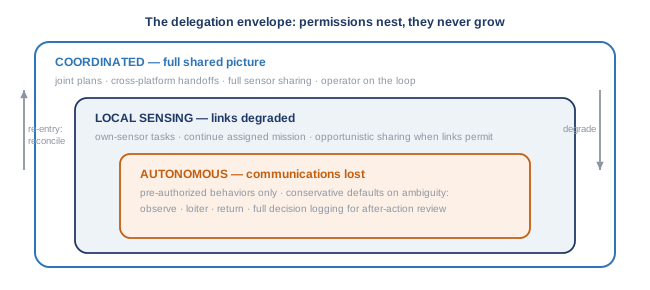
This series has repeatedly invoked a three-tier degradation ladder — coordinated, local sensing, autonomous. The formal content of that ladder is a nesting of permissions: as connectivity degrades, the set of actions a platform may take on its own authority shrinks, never grows.
Stated this way, the ladder stops being a slogan and becomes a checkable specification. For every action class — maneuver, sensor employment, information sharing, and above all any engagement-related behavior — the design document answers one question three times: is this permitted when coordinated, when locally sensing, when isolated? A platform whose answers exist only implicitly, in the emergent behavior of its software, has not delegated autonomy; it has abandoned the question.
Plan together, execute alone
The planning literature supplies the construct that makes bounded isolation useful rather than merely safe. Decentralized POMDP methods embody a principle worth quoting as doctrine: plan centrally, offline, with full knowledge of the mission and each other; execute decentrally, online, each platform following its own pre-computed policy against what it locally observes [1]. The isolated platform is then not improvising — it is executing its branch of a jointly designed plan, whose coordination was baked in before the link ever dropped. The adjustable-autonomy literature adds the operator's half of the contract: transfer-of-control policies that reason explicitly about when decisions should route to a human and what the system does while awaiting an answer that may not come [2]. Both literatures converge on the same shape: autonomy as a designed contract with the operator, parameterized by communications state, rather than a capability switch.
The policy anchor
None of this floats free of doctrine, and the doctrine is public. The Department of Defense's directive on autonomy in weapon systems — DoD Directive 3000.09, reissued in updated form in 2023 — requires that autonomous and semi-autonomous weapon systems be designed to allow commanders and operators to exercise appropriate levels of human judgment over the use of force, and mandates rigorous verification, validation, and review commensurate with that requirement [3]. Read as engineering input, the directive is a specification for the delegation envelope's innermost tier: the isolated-platform action set for anything touching force is drawn conservatively, in advance, by humans, and the system must be demonstrably confined to it. Delegation is thus the opposite of abdication — it is authority exercised early, in the design room, precisely so that it need not be exercised over a jammed link.
Defaults, evidence, and the trip home
Three engineering habits complete the discipline. Conservative defaults under ambiguity: when the isolated platform's situation exits its pre-analyzed envelope — classification uncertain, geometry unanticipated — the specified behavior degrades toward least-harm actions: observe, loiter, return; the burden of proof always rests on acting, never on abstaining. Evidence by construction: every autonomous decision logs the observations and policy branch that produced it, because after-action review is how envelopes improve and how the human-judgment requirement is demonstrated rather than asserted. And re-entry as a first-class transition: the moment the link returns, the platform and network hold divergent pictures accumulated apart — reconciling them is exactly the correlation-honest fusion problem treated earlier in this series, and a platform that rejoins by asserting its isolated picture with full confidence has undone its own discipline. The envelope, the offline plan, the conservative core, the log, the reconciliation: none of it is exotic. It is what taking both autonomy and accountability seriously looks like when written down.
References
- F. A. Oliehoek and C. Amato, A Concise Introduction to Decentralized POMDPs, Springer, 2016.
- P. Scerri, D. V. Pynadath, and M. Tambe, "Towards adjustable autonomy for the real world," Journal of Artificial Intelligence Research, vol. 17, 2002.
- U.S. Department of Defense, Directive 3000.09, Autonomy in Weapon Systems, updated 2023 — public document.
This article synthesizes publicly available academic literature and public reporting. It describes concepts and results from the open published record and contains no Aerodyne technical data, system specifications, or performance information.
Working on coordination or counter-UAS problems?
Aerodyne AI builds mission-planning and coordination software for teams of uncrewed aircraft — and, with AeroVigil, fully passive drone detection for correctional facilities and critical infrastructure, including a limited number of no-cost 90-day pilot evaluations for qualifying facilities.