
Insights · Threat Analysis
Magazine Depth as the Decisive Metric: The Arithmetic That Ends Air-Defense Campaigns
Air-defense campaigns are won by inventories before they are won by intercepts. A defense can defeat every raid it faces and still lose the campaign on the day its magazines empty while the attacker's production line does not — an arithmetic as old as massed air attack and as current as the public reporting from the Red Sea and Ukraine. Magazine depth is the metric that converts tactical success rates into strategic outcomes, and it deserves to be computed, not assumed.
The depletion arithmetic
The core model fits in one line. A defense holding M interceptors, facing raids that force engagements at rate λ and spending k interceptors per kill on average, survives:
Every term is a lever the adversary also holds. Raid mass raises λ directly; decoys raise the effective k by extracting engagements that kill nothing — the pricing attack expressed in inventory units; and doctrine (two shots per threat for confidence) doubles k by the defender's own hand. The sustainability inequality is the sharper teaching: once a campaign runs long, stock M matters less than the production-rate comparison — and the publicly reported comparison of one-way-attack-drone output against interceptor-missile output has run, throughout the current war, orders of magnitude in the attacker's favor.
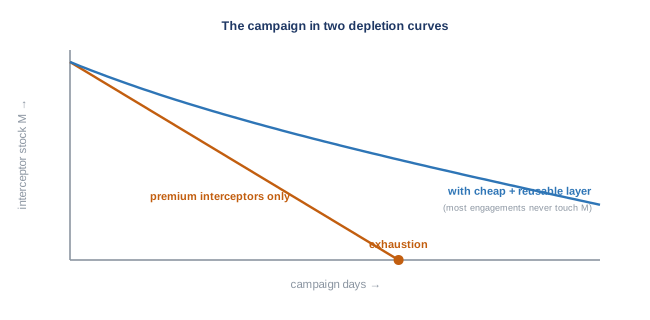
History keeps teaching the same course
The public record offers the lesson at intervals of roughly a generation. The V-1 defense of 1944 succeeded when it stopped being an interceptor problem and became a massed-guns-with-proximity-fuzes problem — a magazine-friendly answer to a mass threat. Gulf-era and later campaigns established the modern cost asymmetry in reverse: exquisite interceptors against cheap ballistic and aerial threats, expenditure figures a matter of public record. The Red Sea engagements of 2023–2024 put the arithmetic on front pages — multi-million-dollar interceptors publicly reported against drones costing thousands, with naval magazines that cannot be reloaded at sea giving the depth question unusual bluntness. And Ukraine's layered adaptation — guns and mobile fire teams, electronic warfare where it still bites, interceptor drones as a new cheap layer, missiles hoarded for what nothing else stops — is depletion arithmetic fielded as doctrine, documented across the analytical literature [2].
Five ways to deepen a magazine
The record and the model agree on the levers, and each connects to a thread this series has already pulled. Cheapen the round: guided rockets, gun systems, and net-class effectors move most engagements to rounds produced in thousands, not hundreds. Reuse the interceptor: a returning interceptor amortizes its cost across sorties and — the inventory view — converts M from a stock that only falls into one that cycles; the visible growth of the reusable-interceptor category on both sides of the current war is this lever being discovered under fire. Spend soft-kill where it still works: jamming costs electricity; every threat it defeats leaves M untouched — with the fiber-optic caveat now permanently attached. Discriminate: every decoy correctly priced and ignored is an interceptor un-spent, which is the magazine-side statement of the classification economics argued earlier. Treat production as strategy: the sustainability inequality says so explicitly, and the artillery-shell experience of this war — production rate as the strategic variable, publicly chronicled — is the same lesson one caliber over.
The metric to demand
The synthesis is a procurement question phrased as arithmetic: for a given defended area and a publicly plausible raid model, what does the ninetieth day look like? A defense architecture answers with its depletion curve — stock, expenditure per kill after discrimination, reload and reuse rates, production behind it. Architectures optimized for the demonstration raid answer with a success percentage; architectures built for the campaign answer with a curve that does not hit zero. The difference between those two answers is the difference this entire series has circled: mass threats are economic instruments, and the defenses that beat them are the ones designed, from the sensor layer to the supply contract, as economies that can afford to keep winning.
References
- W. P. Hughes, Fleet Tactics and Coastal Combat, Naval Institute Press, 2nd ed., 2000 — salvo-exchange and expenditure modeling.
- Public analyses of air-defense expenditure and magazine depth in Ukraine and the Red Sea, 2022–2026, including RUSI reporting (J. Bronk et al.) and CSIS Missile Defense Project commentary on cost-per-intercept.
This article synthesizes publicly available academic literature and public reporting. It describes concepts and results from the open published record and contains no Aerodyne technical data, system specifications, or performance information.
Working on coordination or counter-UAS problems?
Aerodyne AI builds mission-planning and coordination software for teams of uncrewed aircraft — and, with AeroVigil, fully passive drone detection for correctional facilities and critical infrastructure, including a limited number of no-cost 90-day pilot evaluations for qualifying facilities.