
Insights · Autonomy & Swarm Coordination
Mean-Field and Aggregate Methods: Planning for Hundreds Without Simulating Each One
Planning for three coordinating aircraft is a puzzle. Planning for three hundred, by the same methods, is arithmetic suicide: the joint problem grows exponentially with every platform added. The escape route — developed independently by mathematicians, control theorists, and the reinforcement-learning community — is a change of object: stop planning over individuals and plan over the distribution. When the crowd is large enough, the crowd itself becomes the tractable thing.
The blowup, stated honestly
Joint planning treats the whole fleet as one decision-maker whose state is every platform's state and whose action is every platform's action. The spaces multiply:
Decentralization alone does not rescue tractability — the Dec-POMDP results met earlier in this series establish that optimal decentralized planning is intractable in general. The rescue comes from a symmetry observation: in a large fleet of similar platforms, who is where matters far less than how many are where.
The mean-field idea: interact with the crowd, not with everyone
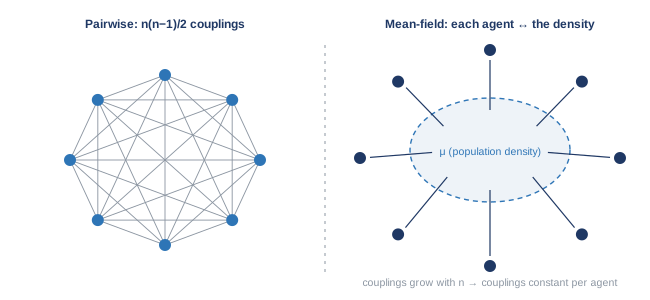
Mean-field theory formalizes that observation. Instead of each agent responding to every other agent — a web of pairwise couplings that grows as n² — each agent responds to the population distribution: a density describing how the fleet (and the threat) is spread over space and state. The foundational mathematics came in two independent streams in the mid-2000s — Lasry and Lions' mean-field games [1] and Huang, Caines, and Malhamé's large-population stochastic control [2] — with the shared central result: as n grows, the interchangeable-agent problem converges to a coupled pair of equations, one describing a representative agent's best response to the density, one describing how the density evolves when everyone plays that response. The learning community then made the idea operational at scale, with mean-field multi-agent reinforcement learning training policies against population aggregates rather than enumerated peers [3].
Why swarms are the natural habitat
Air-defense swarms fit the mean-field mold almost embarrassingly well. The relevant operational picture is a pair of densities — attacker mass flowing across a region, defender coverage arrayed against it — and the natural questions are density questions: where is the raid concentrating, where is coverage thin, how should defender mass flow to meet attacker mass? The distributed coverage-control literature reached the same destination from the control-theoretic side, with provably convergent algorithms that position agents against a spatial density of demand [4]. There is also a quieter systems dividend running back through this series: a density is a compact, additive object — cheap to communicate over degraded links, natural to fuse across nodes, and robust to the loss of any individual contributor — so the mean-field abstraction is not only a planning trick but a bandwidth-and-resilience posture.
The honest boundary
The assumption doing the work is interchangeability, and reality bills for it where it fails. Heterogeneous fleets need multi-population extensions — one density per platform class — which the literature provides at the cost of some elegance. Small engagements, where individual identity genuinely matters (three interceptors, two threats, one decoy), sit below the regime where the approximation earns its keep; there, the explicit assignment machinery of earlier articles remains the right tool. And finite fleets are only approximately mean-field, with corrections that shrink as numbers grow. The mature architecture therefore uses both registers deliberately: aggregate methods to shape the fleet-scale flow — where mass should be — and explicit assignment to resolve the individual engagements inside that flow — who takes which target. The mathematics scales because it stops pretending three hundred aircraft are three hundred separate arguments; the engineering succeeds by remembering when they are.
References
- J.-M. Lasry and P.-L. Lions, "Mean field games," Japanese Journal of Mathematics, vol. 2, 2007.
- M. Huang, P. E. Caines, and R. P. Malhamé, "Large population stochastic dynamic games," Communications in Information and Systems, vol. 6, no. 3, 2006.
- Y. Yang et al., "Mean field multi-agent reinforcement learning," Proceedings of ICML, 2018.
- F. Bullo, J. Cortés, and S. Martínez, Distributed Control of Robotic Networks, Princeton University Press, 2009.
This article synthesizes publicly available academic literature and public reporting. It describes concepts and results from the open published record and contains no Aerodyne technical data, system specifications, or performance information.
Working on coordination or counter-UAS problems?
Aerodyne AI builds mission-planning and coordination software for teams of uncrewed aircraft — and, with AeroVigil, fully passive drone detection for correctional facilities and critical infrastructure, including a limited number of no-cost 90-day pilot evaluations for qualifying facilities.