
Insights · Threat Analysis
The Fiber-Optic FPV: What a Jam-Proof Control Link Changes, Layer by Layer
For a decade, the standard answer to the small hostile drone was electronic: detect its radio link, jam its radio link, hunt its operator through his emissions. Then a spool of glass made all three answers irrelevant for an entire threat class. The fiber-optic FPV — publicly reported in combat from 2024 and mainstream on both sides by 2025 — is the clearest recent case study in how a cheap engineering substitution can invalidate an expensive defensive layer overnight, and in why layered defense is not a slogan but a survival requirement.
What it is, from the public record
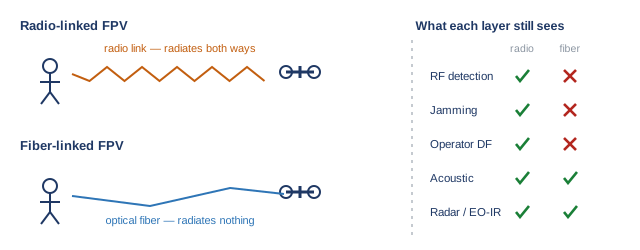
The concept is almost insultingly simple: replace the drone's radio control-and-video link with a hair-thin optical fiber, paid out from a spool as the aircraft flies. Public reporting and manufacturer statements describe spool lengths from a few kilometers to beyond twenty, carrying full-bandwidth, latency-stable video to the operator with zero radiated signature in either direction. The drone emits nothing; the operator emits nothing. The link cannot be detected, cannot be jammed, and cannot be direction-found, because there is no radio to detect, jam, or direction-find. Production has followed the logic: open reporting describes fiber variants moving from improvised novelty to mass manufacture within roughly a year.
What it defeats — the honest ledger
Three defensive investments lose their purchase against this class, and it serves no one to soften the accounting. RF detection networks — the most widely deployed counter-drone sensing on the market — register nothing, because their entire premise is an emitting target. Jamming, the backbone of vehicle- and position-protection against radio FPVs, has no channel to occupy; public reporting from the front repeatedly describes fiber drones striking through jamming bubbles that reliably stop their radio cousins. And operator hunting through emitter geolocation loses its quarry: the operator's position is connected to the aircraft by glass, not by radiation. A defense architecture whose sensing and soft-kill layers are predominantly RF-based is, against this one threat class, largely blind and entirely mute.
The public timeline, briefly
The speed of the adoption curve is itself a finding. Public reporting places the first documented combat employment of fiber-guided FPVs in 2024, initially as a niche answer to jamming-saturated sectors. Within roughly a year, reporting describes both sides fielding the class at scale, dedicated production lines announced, and spool lengths advancing from a few kilometers to ten as typical and beyond twenty in manufacturer claims. By 2025–2026, open-source analysis describes fiber FPVs as a principal instrument of logistics interdiction — strikes on vehicles and supply movement well behind the line, at standoffs that place the contested resupply zone kilometers deep, precisely because the weapon is immune to the roadside jammers that had made those routes survivable. A defensive investment cycle that runs on multi-year programs met an offensive iteration cycle that ran this arc in about twenty-four months; that mismatch, as much as the fiber itself, is the strategic content of the episode.
What it cannot change — physics still collects
The fiber substitution silences the radio, and nothing else. The aircraft still turns motors — the shifting multi-comb acoustic signature this series has examined is unaffected. It still reflects radar energy; still presents a visual and thermal target to EO/IR; still obeys the multilateration geometry of any physical object making noise in the air. The defensive conclusion is not subtle: the fiber FPV is precisely the threat that forces the passive, multi-modal, distributed sensing architecture argued throughout this series — because it is engineered, deliberately and successfully, to defeat every alternative to that architecture.
And the substitution buys its stealth with real tactical costs, all documented in open commentary. The spool adds weight that trades directly against warhead and endurance. The tether constrains flight profile: sharp low turns around obstacles, terrain masking, and certain urban geometries risk snagging or shearing the fiber, and reporting describes both loss modes. The operator, while electromagnetically invisible, is physically within spool range of the target area along a continuous line — a geometric fact with implications for defensive patrolling that public tactical commentary has not been shy about. And glinting fiber, in some light, has reportedly been spotted from the air, marking a line from strike back toward launch. None of these costs neutralize the threat; each is a seam a layered defense can work.
The counter-adaptations taking shape, from open sources
The record of 2025–2026 also shows the defense adapting, and the adaptations map exactly onto the layer analysis above. Physical route protection came first and cheapest: the netting corridors — “net tunnels” — over critical supply roads, widely photographed and reported, which answer a precision weapon with a fence. Acoustic early warning scaled next: nationally networked acoustic sensor arrays, publicly credited in reporting with cueing mobile fire teams against low-flying threats, work identically against fiber FPVs because motors do not care what the control link is made of. Kinetic last-layer answers — shotgun-equipped teams, gun turrets, and interceptor FPVs flown against the attacker — occupy the cheap-effector tier that the engagement-pricing logic elsewhere in this series says such a threat must be met with. And a genuinely new technique appears in public tactical discussion: backtracking the fiber itself, following the glinting line from a strike or a crash toward the launch point — the physical-world revival of the operator-hunting that the fiber was built to defeat electronically. None of these is decisive alone; together they are the multi-layer, multi-phenomenology posture this article's analysis predicts, assembled under fire.
What a buyer should now ask any vendor
The fiber FPV converts neatly into procurement due diligence, because it is the cleanest available test of whether a counter-drone offering is a system or a single assumption. Four questions do the work. Against a target that emits nothing, which of your sensing layers still detect, and at what range — and can you show the answer by modality rather than in aggregate? What fraction of the system's defeat capability is jamming, and what remains when that fraction is subtracted? At the reported standoff depths — strikes arriving from launch points many kilometers away, with no RF warning — what is the sensor-to-response timeline, and which effector tier answers it at a cost that survives repetition? And when the next substitution arrives — because the timeline above says one will — which parts of the system adapt in software and which require new hardware? A vendor with good answers has built for the threat class; a vendor without them has built for last year's raid.
The systems lesson: layers fail independently or they fail together
The deeper point outlives this particular drone. The fiber FPV did not defeat Western or Ukrainian technology; it defeated a single-channel assumption — the assumption that hostile drones emit. Every defensive layer rests on some such assumption: acoustics assumes the target makes noise louder than the wind; radar assumes reflectivity and line of sight; EO assumes weather and daylight or thermal contrast; jamming assumes a link. Sound architecture is the discipline of stacking layers whose assumptions fail independently — so that the engineering substitution which voids one assumption walks the threat directly into a layer built on a different one. The fiber drone voided the emission assumption and thereby walked, un-jammed and un-detected by RF, straight into the acoustic, radar, and optical layers of whoever had bothered to build them. The published record of 2024–2026 is, among other things, a natural experiment in who had.
References
- Public reporting and analysis on fiber-optic FPV employment, production scaling, and countermeasures, 2024–2026, including RUSI commentary and reporting in established defense and general press.
- Public tactical commentary from Ukrainian and Western sources on fiber-drone limitations (spool weight, tether constraints, launch-geometry implications), 2024–2026.
This article synthesizes publicly available academic literature and public reporting. It describes concepts and results from the open published record and contains no Aerodyne technical data, system specifications, or performance information.
Working on coordination or counter-UAS problems?
Aerodyne AI builds mission-planning and coordination software for teams of uncrewed aircraft — and, with AeroVigil, fully passive drone detection for correctional facilities and critical infrastructure, including a limited number of no-cost 90-day pilot evaluations for qualifying facilities.