
Insights · Fusion & Distributed Intelligence
Consistency Over Optimality: Covariance Intersection and Honest Uncertainty
Two nodes in a sensor network each hold an estimate of the same aircraft's position. Fuse them the textbook way and the network becomes more confident than it has any right to be — a mathematically guaranteed overconfidence whenever the two estimates share history. In a system that assigns interceptors based on track accuracy, overconfidence is not a statistical nicety; it is a safety property being violated. Covariance intersection is the fusion rule that refuses to let that happen.
The rumor problem
The textbook fusion rule assumes the two estimates' errors are independent — two genuinely separate looks at the world. Under that assumption, information adds, and the fused uncertainty shrinks below either input:
Now recall how a real battle network behaves: nodes exchange tracks, those tracks are fused, the fusions are exchanged again. Node A's estimate contains, buried inside it, information that originally came from node B. Fusing them "independently" counts that shared information twice — the network equivalent of hearing the same rumor from two friends and treating it as two confirmations, when both friends read the same original post. Each cycle of exchange compounds the double-counting; the covariance shrinks toward a precision no sensor ever delivered, while the actual error does not shrink with it. The literature calls the underlying flaw inconsistency: an estimator whose claimed uncertainty is smaller than its true error [1][2]. In an engagement chain, an inconsistent track is a confident lie.
The fix: fuse as if you don't know the correlation — because you don't
In a dynamic mesh — nodes joining, leaving, relaying over paths nobody centrally records — the true cross-correlation between two estimates is unknowable in practice. Julier and Uhlmann's insight was that a fusion rule can be built to be consistent for every possible correlation, by taking a convex combination in information space [1]:
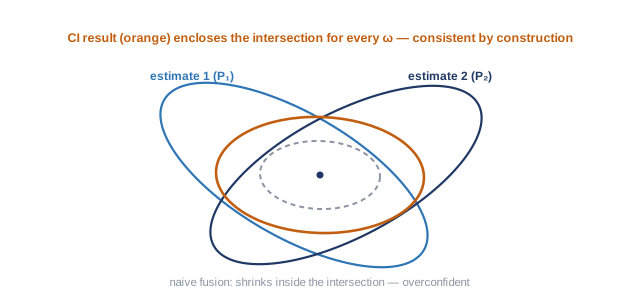
The geometry explains the name and the guarantee at a glance. Draw each input estimate as its uncertainty ellipse. Whatever the unknown correlation, the truth is compatible with the intersection region of the two ellipses — and the CI ellipse, for every choice of ω, encloses that intersection. Naive fusion's ellipse, by contrast, is smaller than the intersection: it claims a precision the inputs cannot jointly justify.
The price, stated honestly
Consistency is bought with conservatism. When the inputs genuinely are independent, CI's ellipse is larger than the optimal one — the rule pays an accuracy premium as insurance against correlations that, that time, didn't exist. The literature offers refinements that split the difference where partial knowledge of correlation structure exists (split and partitioned variants, ellipsoidal-intersection methods), each recovering some tightness in exchange for stronger assumptions [2]. The engineering judgment is a spectrum, not a theorem: how much claimed precision are you willing to trade for a guarantee that the precision you claim is real?
Why this is a battlefield property, not a mathematician's scruple
Every property that makes CI attractive corresponds to a property of degraded battle networks. Topology-agnostic: nodes can fuse whatever arrives, over whatever path, without bookkeeping who told whom — exactly the regime of an ad-hoc mesh under jamming, where information routes change by the minute. Locally computable: the rule needs only the two estimates in hand, no network-wide ledger. And failure-honest: when the picture is genuinely uncertain, the fused track says so, which is what lets the downstream layers — the assignment logic pricing an engagement, the operator weighing a weapons-release decision — behave rationally. A network that degrades gracefully must degrade honestly; covariance intersection is the fusion-layer mechanism by which honesty survives the mesh.
References
- S. J. Julier and J. K. Uhlmann, "A non-divergent estimation algorithm in the presence of unknown correlations," Proceedings of the American Control Conference, 1997.
- Survey treatments of consistent fusion under unknown correlations — including split covariance intersection and ellipsoidal methods — in the IEEE information-fusion literature, 2000–present.
This article synthesizes publicly available academic literature and public reporting. It describes concepts and results from the open published record and contains no Aerodyne technical data, system specifications, or performance information.
Working on coordination or counter-UAS problems?
Aerodyne AI builds mission-planning and coordination software for teams of uncrewed aircraft — and, with AeroVigil, fully passive drone detection for correctional facilities and critical infrastructure, including a limited number of no-cost 90-day pilot evaluations for qualifying facilities.