
Insights · Passive Sensing & Detection
Detecting the Operator, Not Just the Aircraft: Emitter Geolocation in the Open Literature
A hostile drone is the symptom; the operator is the system. Whenever a radio link connects the two, that link points home in both directions — and the discipline of locating radio emitters is among the oldest and best-documented in electronic warfare, with textbook treatments that predate the drone era by decades [1]. Understanding it explains both a defensive capability and, read in reverse, the single most consequential threat evolution of the current war.
Two emitters per drone, not one
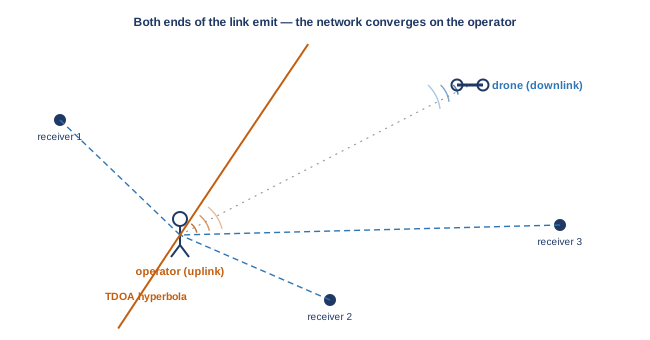
A radio-controlled aircraft is one end of a bidirectional conversation. The downlink — video and telemetry from the aircraft — is the emission most detection systems key on. But the uplink, from the operator's controller, is often the more valuable quarry: it originates at a ground position that changes slowly, transmits with real power to reach a distant aircraft, and marks the human rather than the airframe. For a civilian security operator, locating the person flying over a prison or an airport perimeter is precisely the enforcement action the law permits when almost nothing else is; for a military defender, the same geometry has considerably starker implications, well aired in public reporting. The techniques are identical, and entirely in the open literature.
The geolocation ladder
The measurement families will be familiar to readers of this series' multilateration article, because they are the same geometry pointed at a transmitter. Angle of arrival: directional antennas or arrays at multiple sites each yield a bearing; bearings intersect at the emitter, with the range-proportional error and geometric-dilution behavior derived earlier. Time difference of arrival: synchronized receivers convert the emitter's own waveform into hyperbolic position lines — the classical statistical treatment applies unchanged [2]. And the family member new to this series: frequency difference of arrival, available when receivers move. Each moving receiver hears the emitter Doppler-shifted by its own motion; the difference between two receivers' shifts constrains the emitter to a curve of constant differential Doppler:
What makes it hard in practice
The textbook geometry meets four practical adversaries, all treated candidly in the EW literature [1]. Modern control links are engineered for low probability of intercept — frequency hopping and spread-spectrum waveforms that smear energy thin — so competent geolocation begins with wideband receivers and correlation processing that exploits the very structure hiding the signal. Duty cycle compounds it: a disciplined operator keys briefly and moves, so the system must measure in seconds and fuse across intermittent glimpses — a track-before-locate problem cousin to the association machinery of earlier articles. Urban and terrain multipath bends bearings and corrupts timing, pushing practice toward many diverse sites over few good ones — the density argument again. And the emitter may be a relay: reporting and literature alike note repeater architectures that put the locatable transmitter somewhere other than the operator, which locating still degrades, but honestly.
The arms race's ending, and its lesson
Read this article beside the fiber-optic FPV analysis and the series closes a loop: operator geolocation worked well enough, publicly and repeatedly, that the threat evolved to stop emitting altogether. The spool of glass is, among other things, this discipline's success measured in the adversary's engineering budget. The defensive conclusion is the series' standing theme with a new proof point: emitter location remains a high-value layer — most drones still radiate, and every operator located is a system defeated rather than an airframe — but it is a layer, whose assumption (the link exists) the adversary has now demonstrated the will to void. The architecture that survives that voiding is the one where the emission-hunting layer sits beside acoustic, radar, and optical layers that never needed the assumption at all.
References
- R. A. Poisel, Electronic Warfare Target Location Methods, 2nd ed., Artech House, 2012.
- D. J. Torrieri, "Statistical theory of passive location systems," IEEE Transactions on Aerospace and Electronic Systems, vol. AES-20, no. 2, 1984.
- S. Stein, "Algorithms for ambiguity function processing," IEEE Transactions on Acoustics, Speech, and Signal Processing, vol. 29, no. 3, 1981.
This article synthesizes publicly available academic literature and public reporting. It describes concepts and results from the open published record and contains no Aerodyne technical data, system specifications, or performance information.
Working on coordination or counter-UAS problems?
Aerodyne AI builds mission-planning and coordination software for teams of uncrewed aircraft — and, with AeroVigil, fully passive drone detection for correctional facilities and critical infrastructure, including a limited number of no-cost 90-day pilot evaluations for qualifying facilities.