
Insights · Programs & Policy
Allied Co-Development Mechanisms: The NATO Innovation Programs, From the Public Record
Alliance defense innovation used to mean interoperability standards and the occasional joint program measured in decades. The public record of 2022–2026 shows something structurally new: a family of standing mechanisms — accelerators, a sovereign-backed venture fund, and joint contract competitions — built to move technology across allied borders at commercial speed. For any company contemplating cross-border defense work, these mechanisms are the map. Here they are, from their own public materials.
Three instruments, three theories of change
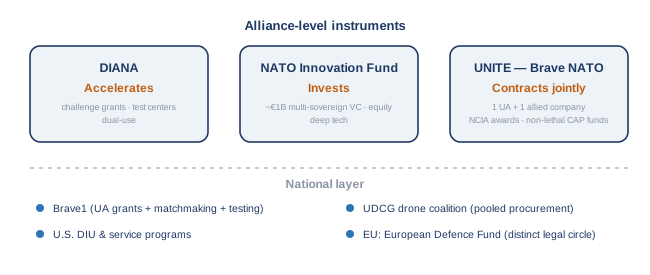
The alliance-level architecture divides cleanly by instrument. DIANA — the Defence Innovation Accelerator for the North Atlantic — is the grant-and-accelerate instrument: open challenge calls on published dual-use problem sets, non-dilutive awards to selected companies, structured acceleration, and access to a network of test centers across member nations. Its theory of change is deal flow: surface promising dual-use technology early and connect it to alliance end users. The NATO Innovation Fund is the capital instrument: a multi-sovereign venture fund, backed by roughly two dozen allied governments with about one billion euros, investing equity in deep-tech companies and funds across participating nations — patient capital whose theory of change is that strategic technologies need strategic shareholders. And the newest layer is the joint-contract instrument, of which the flagship is UNITE — Brave NATO: a program run by NATO's innovation apparatus with Ukraine's Brave1 cluster, in which teams of one Ukrainian and one allied company jointly develop solutions to published challenges — counter-UAS and air defense first — with contracts issued on the NATO side by the NCIA, funding split between the partners, the NATO side drawn from assistance funds limited to non-lethal categories, and validation available through Ukraine's own test infrastructure. Its theory of change is the bluntest of the three: pair combat-proven Ukrainian iteration speed with allied technology and market access, and contract the pairing directly.
The national layer underneath
The alliance instruments sit atop a thicker national layer, and the public record shows the two interleaving. Brave1, Ukraine's government-backed defense-tech cluster, runs its own grant programs, maintains the matchmaking and testing infrastructure that UNITE builds on, and has become the de facto interface between Ukraine's several-hundred-company drone sector and foreign partners. Capability coalitions under the Ukraine Defense Contact Group — most relevantly the drone coalition co-led by Latvia and the United Kingdom — pool national contributions to procure at scale from exactly that sector. The United States channels its own commercial-speed instruments through the Defense Innovation Unit and related programs. And the European Union runs a parallel, legally distinct track — the European Defence Fund and its successors — which is an EU instrument, not a NATO one: a distinction with real consequences for eligibility, since EU funding rules and NATO program rules draw their membership circles differently, and a company can be inside one and outside the other.
Reading the mechanisms as a company
Viewed from a company's chair, the instruments answer different questions and impose different disciplines, all stated in their public documentation. Accelerator grants answer "is this technology promising?" — they are non-dilutive, competitive, and calibrated to early maturity. Sovereign venture answers "should this company exist at scale?" — it prices equity and expects returns on venture timelines. Joint contracts answer the hardest question, "will this pairing produce a fieldable solution?" — and accordingly impose the heaviest structure: eligibility attestations through national channels, teaming agreements between partners who may never have met before the matchmaking round, funding-category constraints (the non-lethal boundary on alliance assistance funds shapes which half of a joint solution each side's money can touch), and validation in operationally realistic conditions. The published guidance across all three converges on the same practical counsel: eligibility work — national declarations, compliance screening, export posture — belongs at the front of the calendar, because it moves at government speed while everything else in these programs is deliberately built to move faster.
What the trend line says
The pattern across the public record is unmistakable in direction: budgets stepping up round over round, challenge sets tracking the drone-and-counter-drone lessons of the current war, and — most significantly — the joint-team requirement spreading, on the explicit public rationale that combat-validated iteration and allied industrial depth are complements, not competitors. For the defense-technology ecosystem this amounts to standing infrastructure for cross-border teaming where a decade ago there was none: published challenges, matchmaking machinery, split funding, and test ranges with real weather over them. The mechanisms reward the same qualities on both sides of every pairing — legible capability, honest maturity claims, and paperwork done early — which is perhaps the most encouraging thing the public record has to say.
References
- NATO public materials: DIANA programme descriptions and challenge calls (diana.nato.int); NATO Innovation Fund public announcements; NATO and NCIA announcements of the UNITE — Brave NATO programme, 2025–2026.
- Brave1 public programme materials (brave1.gov.ua) and Ukrainian Ministry of Defence announcements; public statements of the UDCG drone capability coalition; European Defence Fund public documentation (defence-industry-space.ec.europa.eu).
This article synthesizes publicly available academic literature and public reporting. It describes concepts and results from the open published record and contains no Aerodyne technical data, system specifications, or performance information.
Working on coordination or counter-UAS problems?
Aerodyne AI builds mission-planning and coordination software for teams of uncrewed aircraft — and, with AeroVigil, fully passive drone detection for correctional facilities and critical infrastructure, including a limited number of no-cost 90-day pilot evaluations for qualifying facilities.