
Insights · Autonomy & Swarm Coordination
Decoy Discrimination as a Pricing Problem: Game Theory Against Saturation-by-Cheapness
The cheapest way to defeat an air defense is not to penetrate it but to bankrupt it — and the instrument of bankruptcy is the decoy. A target that costs a fraction of an armed aircraft, looks enough like one to demand a response, and converts every response into a losing trade turns the defender's own decision rule into a weapon against him. Which means the defender's decision rule is exactly where the fix must live: engagement is a purchase, and purchases have prices.
The engagement as a transaction
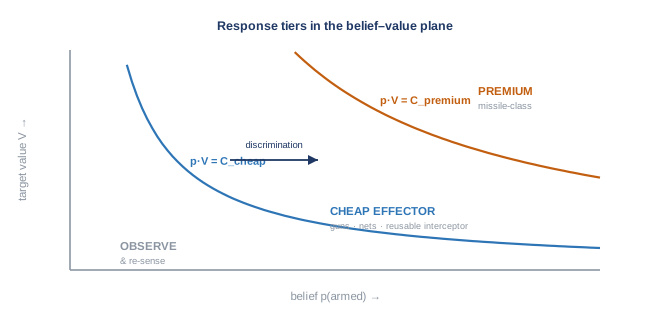
Strip an engagement decision to its economic skeleton and it is an expected-value comparison: fire when the expected damage prevented exceeds the cost of firing.
The formula's blunt teaching: with an expensive interceptor and a valuable target, p* is low — the defender must engage even quite doubtful tracks, which is precisely the vulnerability decoys exploit. The attacker's optimal move is to manufacture doubt at scale: cheap airframes that push the defender's parmed above p* while costing less than Cint. The public record of the current war shows this play run deliberately — dedicated decoy variants flown in mixed salvos, documented openly — and the salvo-combat literature has modeled the exhaustion mechanics for decades [1].
A signaling game, with bluffing
Formally the situation is a signaling game: the attacker chooses what each airframe looks like, the defender chooses responses based on looks — the same structure economics has studied since the classic signaling literature [2], and the same one every poker player knows viscerally. Two consequences transfer directly. First, the attacker will spend to make decoys resemble armed variants exactly up to the point where mimicry costs more than it extracts — so the defender's discriminating features should be the ones that are expensive to fake: propulsion class betrayed by acoustics, radar micro-characteristics, kinematic behavior under observation, rather than paint and planform. Second, the defender must sometimes "call" cheaply: a mixed strategy that answers low-confidence tracks with low-cost responses denies the pure-bluff strategy its profit, where a defender who answers everything with premium interceptors is simply a machine for converting decoys into expenditure.
Sensors as repricing instruments
This frame gives classification its correct valuation: a sensor that shifts parmed is not producing information for its own sake — it is repricing the engagement. Evidence that moves a track's posterior from 0.5 to 0.95, or to 0.05, converts a forced ambiguous purchase into either a confident one or a declined one; summed over a raid, the value of the classification layer is the expenditure it avoids. This is why the multi-modal arguments running through this series carry economic weight beyond detection range: a propulsion class read acoustically is a costly-to-fake signal that directly separates airframe types, and a cued optical confirmation is often the cheapest interceptor never fired.
The arithmetic, worked once
Concrete numbers make the mechanism unmistakable. Let the defended asset justify V = $10 million of damage prevented, and let the premium interceptor cost C = $400,000 all-in. The threshold is p* = 4%: any track the defender believes is even one-in-twenty-five likely to be armed must be engaged on expected value. Now the attacker fields a $10,000 decoy good enough to sustain a 4% belief — a low bar, since at that threshold the defender cannot afford much skepticism. Each decoy extracts a $400,000 response for a $10,000 outlay: forty to one, repeatable nightly. Add a cheap-effector tier at C = $10,000, and the same decoy extracts only its own cost — the bluff earns one-to-one and dies as a strategy. Now price the classification layer the same way: a raid of sixty aircraft, half armed, half decoys. With no discrimination, all sixty clear the 4% threshold and draw premium responses: $24 million spent. With sensing that moves posteriors to 0.95 and 0.05 and a tiered ladder underneath, thirty armed aircraft draw premium engagements ($12 million) while thirty decoys draw observation and cheap responses (well under $1 million): the classification layer was worth roughly $11 million in that single raid. That is the number a sensor's business case should be written in.
History already ran this experiment
None of this is speculative; the twentieth century ran the experiment repeatedly, on the public record. Chaff — wartime “Window” — was the primordial cheap decoy, saturating radar pictures with false targets for the price of cut foil, and it worked until signal processing learned to discriminate the returns. In the 1982 Bekaa Valley air campaign, publicly documented employment of unmanned decoys induced air-defense batteries to reveal positions and expend missiles against targets worth a fraction of the response — the pricing attack executed at operational scale, with the SEAD strikes arriving on the emissions thus purchased. The modern MALD-class air-launched decoy is the institutionalized version: a catalog item whose entire specification is “be worth engaging.” And the Gerbera flying today in mixed salvos is the same instrument at commodity prices. The pattern across all four is identical and encouraging in one respect: each decoy generation profited exactly until the defense fielded discrimination that was costly for the decoy to defeat — pulse-Doppler processing against chaff, emission discipline and kinematic analysis against SEAD decoys — at which point the economics inverted. Decoys are not defeated by indignation or by volume of fire; they are defeated by repricing, every time.
Tiering: match the posterior to the price
The full repair is structural, and it unifies threads from across this series: hold a ladder of responses with a ladder of costs — continued observation, gun and net-class effectors, reusable interceptors, premium missiles — and let the assignment layer choose the cheapest response whose expected effectiveness clears the track's posterior-weighted value. In the decision plane, that is exactly what the cost curves draw: each tier owns a region, and a track's classification history is a trajectory across regions. The layered-by-cost architecture visible in public reporting from Ukraine — guns and mobile fire teams under interceptor drones under scarce missiles — is this diagram fielded under necessity. The design lesson for anyone building the deciding layer is correspondingly precise: decoy resistance is not a classifier accuracy number; it is the joint property of costly-to-fake sensing, honest posteriors, and a response ladder priced so that being fooled is affordable. Get those three right, and the decoy — the attacker's cheapest weapon — becomes his least profitable one.
References
- W. P. Hughes, Fleet Tactics and Coastal Combat (salvo-exchange models), Naval Institute Press, 2nd ed., 2000.
- M. Spence, "Job market signaling," Quarterly Journal of Economics, vol. 87, no. 3, 1973 — the canonical treatment of costly signaling, whose logic transfers directly to decoy design and discrimination.
This article synthesizes publicly available academic literature and public reporting. It describes concepts and results from the open published record and contains no Aerodyne technical data, system specifications, or performance information.
Working on coordination or counter-UAS problems?
Aerodyne AI builds mission-planning and coordination software for teams of uncrewed aircraft — and, with AeroVigil, fully passive drone detection for correctional facilities and critical infrastructure, including a limited number of no-cost 90-day pilot evaluations for qualifying facilities.