
Insights · Programs & Policy
Detection at Home: The U.S. Legal Framework for Civilian Drone Detection
In the United States, the question "may I detect drones over my facility?" has a surprisingly intricate answer, and the question "may I stop one?" has a brutally simple one. The framework is a patchwork of communications law, aviation law, and computer-crime law, mapped publicly in a joint federal advisory — and its central, counterintuitive feature is that how a system detects determines whether it is lawful. This is a survey of the public statutes, not legal advice; operators should consult counsel on their specific deployments.
The map, in one advisory
The authoritative public starting point is the 2020 interagency advisory issued jointly by the Department of Justice, FAA, DHS, and FCC on the use of UAS detection and mitigation technologies [1]. Its structure is the field's structure: detection technologies are analyzed against federal communications and surveillance statutes; mitigation technologies are analyzed against those plus aviation-safety and computer-crime statutes; and the conclusion for non-federal actors is asymmetric in the extreme — some detection is broadly available, while mitigation is, as a practical matter, closed.
Detection: the modality decides the legality
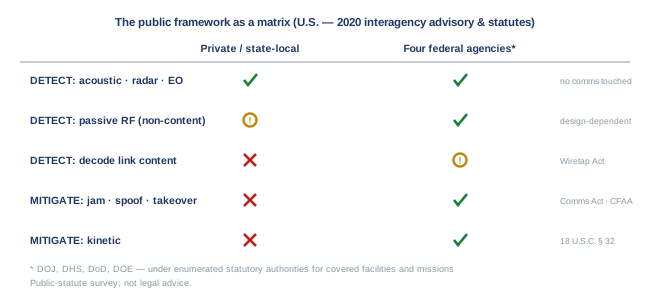
The statutes that matter for detection are the federal wiretap and surveillance laws — chiefly the Wiretap Act's prohibition on intercepting the contents of electronic communications, and the related pen-register/trap-and-trace regime governing non-content signaling information [2]. Their reach maps directly onto sensor architecture. A detection system that demodulates a drone's video downlink is acquiring communications content, squarely in the Wiretap Act's territory. A system that reads RF signaling characteristics without content sits in a grayer, advisory-flagged zone that the 2020 document treats with visible caution. And a system built on acoustics, radar, or electro-optics intercepts no communication at all — there is no signal acquired, no content or non-content data of a "communication" in play, and the entire surveillance-law analysis simply never attaches. The advisory says as much in its technology-by-technology treatment: the further a sensor stands from the drone's radio link, the shorter its legal exposure. It is difficult to overstate how much architectural consequence hangs on that one distinction — a passive acoustic-and-radar detection network is not a cleverly lawyered RF system; it is a system to which the hardest statutes were never addressed.
Mitigation: four agencies, and nobody else
The other half of the map is short. Jamming a drone's link violates the Communications Act's interference and unlawful-devices provisions — the FCC's position on jammers admits no private exception. Taking control of a drone raises the Computer Fraud and Abuse Act. And physically downing one collides with the federal aircraft-sabotage statute, because an unmanned aircraft is an aircraft in the statute's eyes — destroying it is the same federal crime as sabotaging any other [2]. Congress addressed the resulting paralysis for the government's own protective missions by exception, not by liberalization: the Preventing Emerging Threats Act of 2018 gave DOJ and DHS specific counter-UAS authority for covered facilities and missions, joining earlier grants to the Departments of Defense and Energy [3]. Four departments, enumerated missions, required policies and reporting — and no authority for states, localities, critical-infrastructure owners, stadiums, or prisons. The advisory's practical counsel to everyone else follows: detect lawfully, coordinate with the FAA and law enforcement, and locate the operator, because arresting the person flying is the enforcement action that general law has always permitted — which is where the geolocation techniques of this series' companion article acquire their civil significance.
The direction of travel
The framework is publicly acknowledged — by the advisory's own signatories in congressional testimony — to lag the threat, and Congress has repeatedly considered expansions: extending mitigation authority to additional agencies, piloting state and local participation under federal oversight, and clarifying detection rules. Proposals have recurred in successive sessions alongside the periodic reauthorizations of the existing authorities; readers should check the current status, which this survey deliberately does not freeze. What can be said durably is the design lesson the statute book has already taught the industry: in the civilian domain, detection architecture is compliance architecture. Systems that sense without touching the radio link inherit the cleanest legal posture available, systems that must touch it inherit statute-aware engineering obligations, and systems that promise private mitigation inherit felonies. The market's visible migration toward passive, non-RF-dependent detection for airports, corrections, and critical infrastructure is not only the technical trend this series has argued from physics — it is what the United States Code, read carefully, has been recommending all along.
References
- Department of Justice, Federal Aviation Administration, Department of Homeland Security, and Federal Communications Commission, Advisory on the Application of Federal Laws to the Acquisition and Use of Technology to Detect and Mitigate Unmanned Aircraft Systems, August 2020 — public document.
- Public statutes discussed: 18 U.S.C. § 2511 (interception); 18 U.S.C. §§ 3121–27 (pen register/trap and trace); 47 U.S.C. §§ 302a, 333 (unlawful devices; interference); 18 U.S.C. § 1030 (CFAA); 18 U.S.C. § 32 (destruction of aircraft).
- Preventing Emerging Threats Act of 2018, codified at 6 U.S.C. § 124n; Department of Defense authority at 10 U.S.C. § 130i; Department of Energy authority at 50 U.S.C. § 2661.
This article synthesizes publicly available academic literature and public reporting. It describes concepts and results from the open published record and contains no Aerodyne technical data, system specifications, or performance information.
Working on coordination or counter-UAS problems?
Aerodyne AI builds mission-planning and coordination software for teams of uncrewed aircraft — and, with AeroVigil, fully passive drone detection for correctional facilities and critical infrastructure, including a limited number of no-cost 90-day pilot evaluations for qualifying facilities.