
Insights · Programs & Policy
NDAA Compliance and Blue UAS: What “Compliant” Means and Why Allies Care
"NDAA-compliant" appears on drone-industry marketing the way "organic" appears on groceries — often, confidently, and with varying relationship to the underlying rules. The rules themselves are public, specific, and consequential: they determine which aircraft and which components the U.S. government may buy or operate, and they increasingly shape what allied buyers demand. Here is what the phrase actually means, from statute to shopping list.
The statutes: two layers of prohibition
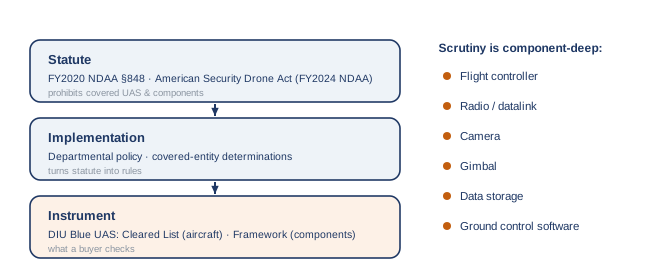
The foundation is Section 848 of the FY2020 National Defense Authorization Act, which barred the Department of Defense from operating or procuring unmanned aircraft systems — and specified covered components — manufactured in "covered foreign countries," a definition aimed principally at the People's Republic of China. The American Security Drone Act, enacted within the FY2024 NDAA, extended the prohibition government-wide: federal agencies broadly may not procure or operate covered UAS, with restrictions phasing in on the use of federal funds — including grants to state and local entities — for such purchases. Together the two statutes converted supply-chain origin from a preference into a legal boundary, and their coverage of components, not just finished aircraft, is the detail that does most of the work.
From statute to shopping list: Blue UAS
A prohibition is not a procurement tool; contracting officers need something to check. The Defense Innovation Unit's Blue UAS effort fills that role in two public forms: the Cleared List of complete aircraft vetted for policy compliance and cybersecurity, and the Blue UAS Framework of vetted components — flight controllers, radios, cameras, and related subsystems — from which compliant aircraft can be built. Two clarifications from the public record prevent the most common misreadings. Being on the Blue list is sufficient evidence of compliance for many buyers, but it is not the only lawful path — an aircraft can satisfy the statutes without appearing on any list, though it then carries its own burden of proof. And the scrutiny is genuinely component-deep: the covered categories in statute include flight controllers, radios and data-transmission devices, cameras, gimbals, and ground control software — so a Western-assembled airframe wrapped around a covered-country flight controller is not compliant assembly; it is a prohibited component with extra steps.
What compliance actually costs, and buys
The public record is candid about the trade. Compliant components have historically cost more and iterated slower than the covered-country commercial ecosystem they replace — a gap repeatedly noted in reporting and in the government's own program justifications, and one that has narrowed as the compliant supplier base has grown. What compliance buys is market access with compounding scope: eligibility for U.S. defense and federal purchases, for the growing set of state procurements that mirror federal rules, and — decisive for exporters — for purchases anywhere that U.S. funds are involved, since money carries its rules with it. It also buys something less tangible that the public discussion increasingly names: assurance about data paths and update channels in aircraft that are, functionally, flying computers.
Why allies care — and increasingly copy
For allied governments and companies, the U.S. framework matters through three channels, all visible in the open record. First, interoperability with U.S. forces and eligibility for U.S.-funded programs make compliance a de facto export requirement for anyone selling into the alliance's largest market. Second, allied governments have moved in the same direction on their own authority — supply-chain security reviews for uncrewed systems are now standard fare in European and Indo-Pacific defense policy, frequently referencing the U.S. component categories. Third, and most immediately for joint development: a co-developed product intended for both an allied home market and the U.S. one must be compliant from the design stage, because retrofitting a supply chain is rebuilding the aircraft. In international teaming, then, "who supplies the flight controller and the radio" is not an engineering detail deferred to integration — it is a market-access decision made on day one, and the partners who treat it that way are the ones whose joint product can actually be sold where the money is.
References
- National Defense Authorization Act for Fiscal Year 2020, § 848 (Pub. L. 116-92); American Security Drone Act of 2023, enacted within the FY2024 NDAA (Pub. L. 118-31) — public statutory texts.
- Defense Innovation Unit, public Blue UAS program materials: Cleared List and Blue UAS Framework component descriptions, diu.mil.
This article synthesizes publicly available academic literature and public reporting. It describes concepts and results from the open published record and contains no Aerodyne technical data, system specifications, or performance information.
Working on coordination or counter-UAS problems?
Aerodyne AI builds mission-planning and coordination software for teams of uncrewed aircraft — and, with AeroVigil, fully passive drone detection for correctional facilities and critical infrastructure, including a limited number of no-cost 90-day pilot evaluations for qualifying facilities.