
Insights · Programs & Policy
How SBIR/STTR Actually Transitions Technology: Phase I to Phase III, From the Public Record
America's small-business research programs are frequently described and rarely explained. SBIR and STTR move roughly four billion dollars a year from federal R&D budgets into small companies — but the interesting machinery is not the grants; it is the transition path: how a feasibility study becomes a funded prototype, how a prototype becomes a sole-source production contract, and why the data-rights clock is the most valuable clause most observers never read. Everything below is from the public record — statute, the SBA's policy directive, and agency practice.
The set-aside, and the three phases
By statute, every federal agency with a large extramural R&D budget must reserve a fixed slice for small business: currently 3.2% for SBIR and 0.45% for STTR. The money flows through a three-phase structure. Phase I funds a feasibility study — months of work, awards on the order of one to three hundred thousand dollars — whose real product is evidence. Phase II funds the prototype: roughly two years and on the order of one to two million dollars, the stage where research becomes a demonstrable thing. Phase III is the destination and the most misunderstood stage: it is not an SBIR award at all. Phase III work is funded with ordinary procurement or non-SBIR R&D dollars, is uncapped, and carries a statutory preference that agencies pursue it with the SBIR-originating firm — the basis for sole-source Phase III contracts. The phase structure, in other words, is a bridge from set-aside seed money to the regular defense market.
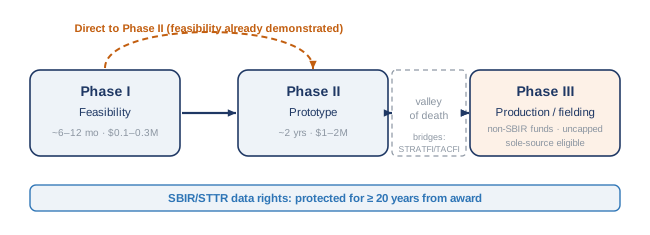
Two structural refinements matter to anyone reading a company's pipeline. Direct to Phase II lets an agency skip Phase I when the firm can show feasibility is already demonstrated — a mechanism that both rewards prior self-funded work and signals, in any proposal list, which efforts arrived with evidence in hand. And STTR differs from SBIR in one deliberate respect: it requires a formal research-institution partner, with at least 30% of the work performed by the institution and at least 40% by the small business — Congress's standing instrument for pulling university research into commercializable form.
The crown jewel: twenty years of data rights
The clause that gives the whole structure its commercial teeth is data rights. Under the SBA's governing policy directive, technical data and software generated under an SBIR or STTR award are protected from government disclosure and unauthorized use for not less than twenty years from award — during which the government receives limited rights, and competitors receive nothing. The strategic consequence compounds across a portfolio: a firm that develops successive components under successive awards accumulates a stack of protected technical packages, and a program office that wants the resulting integrated capability has, as a practical matter, one place to buy it. Phase III's sole-source preference and the data-rights clock are two halves of one design: the first makes the follow-on contract lawful without competition; the second makes competition impractical anyway. Public policy literature debates the wisdom of this design; no one debates its mechanics.
The valley, and the bridges built over it
The path's famous failure mode sits between Phase II and Phase III: the valley of death, where a working prototype waits for a program of record with budget authority to adopt it — a gap documented for decades in GAO and academic reviews of the program. The public record also shows the bridges agencies have built: matching-fund constructs such as the Air Force's TACFI and STRATFI supplements, which extend Phase II efforts into the multi-million-dollar range when private or program dollars match; sequential Phase II awards; and, for the Department of Defense broadly, a procurement culture increasingly graded on transition rates rather than award counts. For a company, the practical lesson from the record is equally blunt: transition is engineered from the first proposal — by choosing topics whose sponsoring offices own budgets, writing prototypes toward fieldable form, and treating the commercialization volume as a plan rather than a formality.
Why this matters to allies and partners
For a non-U.S. reader — a potential co-development partner, an allied program office — the structure explains something otherwise puzzling: how very small American firms credibly promise very large outcomes. An SBIR-funded company is not merely grant-funded; it is holding a statutory lane into U.S. defense procurement, protected technical data, and a sole-source pathway that survives competition rules. A joint product built with such a firm inherits access to that lane for its U.S. market entry — which is why, in international teaming, the American partner's SBIR posture is due diligence material, not trivia. The program's periodic congressional reauthorizations, its agency-by-agency variations, and its published solicitations are all public; the machinery rewards partners who read it.
References
- 15 U.S.C. § 638 (Small Business Innovation Research and Small Business Technology Transfer programs) and the SBA SBIR/STTR Policy Directive (data rights, phase structure, set-aside percentages), current editions at sbir.gov.
- U.S. Government Accountability Office, public reports on SBIR/STTR transition and commercialization outcomes, multiple years.
- U.S. Air Force AFWERX public program descriptions of TACFI/STRATFI supplemental funding.
This article synthesizes publicly available academic literature and public reporting. It describes concepts and results from the open published record and contains no Aerodyne technical data, system specifications, or performance information.
Working on coordination or counter-UAS problems?
Aerodyne AI builds mission-planning and coordination software for teams of uncrewed aircraft — and, with AeroVigil, fully passive drone detection for correctional facilities and critical infrastructure, including a limited number of no-cost 90-day pilot evaluations for qualifying facilities.