
Insights · Fusion & Distributed Intelligence
Latency Budgets in Engagement Chains: Lessons From Microsecond Infrastructure
An air-defense engagement chain is a real-time system with a deadline set by physics: while your software deliberates, the threat moves. Financial trading infrastructure spent two decades learning to meet microsecond deadlines under adversarial load, and most of what it learned transfers — not the microseconds themselves, but the engineering discipline of budgeted, measured, tail-honest latency. The lessons are general enough to state entirely from the public engineering literature.
The budget, and what a millisecond costs
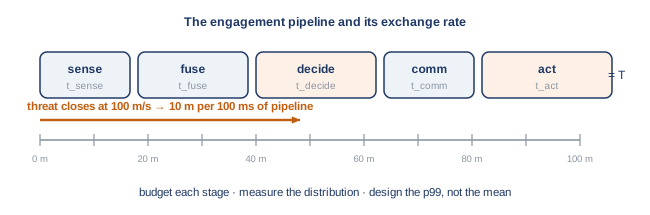
Every engagement chain is a pipeline — sense, fuse, decide, communicate, act — and its end-to-end time is the sum of its stages. The exchange rate between time and ground is fixed by the threat:
The discipline this forces is the same one hard real-time and trading systems practice: give every stage an explicit budget, measure every stage in production against it, and treat a budget overrun as a defect, not a shrug. A chain nobody has decomposed into budgets is a chain nobody actually controls — its total latency is an emergent surprise rather than an engineered number. The military literature reached the same destination by its own road: Boyd's observe–orient–decide–act construct is, among other things, the claim that the faster complete loop wins.
Averages lie; tails decide
The most transferable single lesson from large-scale low-latency practice is distributional honesty: mean latency is a marketing number; the tail is the truth. Systems that are fast on average are routinely slow at the 99th percentile — garbage collection, lock contention, queue buildup, retransmissions — and the canonical treatment of why tails dominate at scale is Dean and Barroso's "The Tail at Scale" [1]. For an engagement system the tail is not a service-quality nuance, because a saturation raid samples the distribution many times at once:
The design consequences are the trading floor's, verbatim: engineer for the percentile that matters, not the mean; hunt and remove sources of jitter (unbounded queues, stop-the-world pauses, incidental synchronization) rather than merely averaging over them; and publish internal latency numbers as distributions, because a system whose builders quote only averages has told you which question they haven't asked.
Load is the weapon: backpressure and graceful shedding
A saturation raid is, in systems terms, a deliberately engineered load spike — the adversary is attacking your queues as much as your interceptors. Queueing theory's most elegant identity says what happens next:
A track that queued for two seconds describes where an aircraft was; acting on it is acting on the past. The engineered response, again standard in latency-critical practice, is bounded queues with principled shedding: under overload, drop the stale in favor of the fresh, degrade the cheap computations before the critical ones, and shed by priority — which for an engagement system means the threat-value logic of the assignment layer reaching down into the plumbing. Overload behavior is not an edge case to be discovered during the first real raid; it is a design surface, specified and tested, because the adversary will specify it for you otherwise.
Time itself is infrastructure
One final transfer from both trading floors and the multilateration geometry earlier in this series: distributed latency engineering presupposes distributed clocks. Cross-node budgets cannot be measured, stale data cannot be identified, and fusion windows cannot be aligned without synchronized time — and the synchronization itself is attackable infrastructure, to be designed with the same adversarial assumptions as everything else. The summary discipline is one sentence long: treat time as a first-class engineered resource — budgeted per stage, measured as a distribution, defended under load and attack — and the chain's speed becomes a property you own rather than weather you experience.
References
- J. Dean and L. A. Barroso, "The tail at scale," Communications of the ACM, vol. 56, no. 2, 2013.
- J. D. C. Little, "A proof for the queuing formula L = λW," Operations Research, vol. 9, no. 3, 1961.
This article synthesizes publicly available academic literature and public reporting. It describes concepts and results from the open published record and contains no Aerodyne technical data, system specifications, or performance information.
Working on coordination or counter-UAS problems?
Aerodyne AI builds mission-planning and coordination software for teams of uncrewed aircraft — and, with AeroVigil, fully passive drone detection for correctional facilities and critical infrastructure, including a limited number of no-cost 90-day pilot evaluations for qualifying facilities.