
Insights · Threat Analysis
The One-Way Attack Drone Family Tree: Reading an Evolving Lineage From the Public Record
"Shahed" has become shorthand, but the shorthand hides the real story: not one aircraft but a design lineage, iterating in wartime at a pace conventional weapons programs cannot match. The public record of 2022–2026 lets that lineage be read like an evolutionary tree — and read correctly, it is less a catalog of variants than a study in how an adversary's engineering priorities trace the defender's countermeasures, cheapest first.
Roots and trunk
The concept is older than the war: loitering munitions with pre-programmed or emitter-homing guidance date to the anti-radiation designs of the 1980s and 1990s, well documented in open defense literature. The current trunk is the Iranian Shahed-131 and larger Shahed-136 — delta-winged, piston-engined airframes navigating by inertial and satellite guidance — which entered mass employment against Ukraine in late 2022 under the Russian designation Geran-2, with production subsequently localized at scale inside Russia; the industrial buildup, including the widely reported Alabuga facility, has been documented extensively in public investigations. The trunk's defining property was never performance; it was price and quantity — an aircraft cheap enough to spend in dozens per night, per the saturation economics examined earlier in this series.
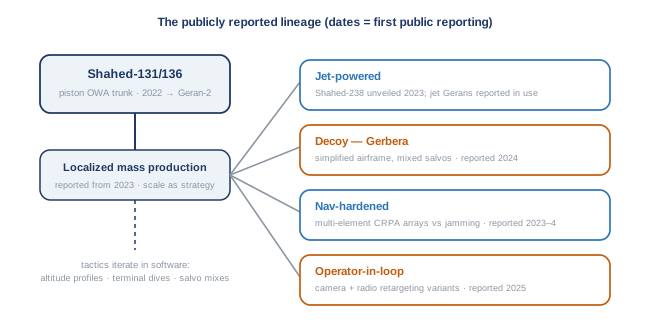
The branches, and what each one answers
Read each publicly reported branch as a response to a specific defensive success, and the tree annotates itself. Navigation hardening: as satellite-navigation jamming and spoofing bit, reporting documented variants carrying multi-element controlled-reception-pattern antennas — arrays designed to null jammers — turning a soft-kill countermeasure into an arms race the defender no longer wins for free. Speed: the publicly unveiled jet-powered branch (Shahed-238, with jet-powered Geran variants subsequently reported in use) trades cost and range for velocity — a direct answer to gun-and-interceptor layers whose engagement timelines were built for a 180 km/h target, and an illustration of the timeline compression discussed in the acoustics article. Tactics in software: public reporting has tracked altitude-profile changes — low to evade radar coverage, then high above gun layers — and terminal dives, costless changes that reprice existing defenses without touching the airframe. The decoy branch: the widely reported Gerbera — a simplified, far cheaper airframe flown in mixed salvos, some unarmed, some carrying warheads or sensors — is the pricing attack of the previous article made sheet-metal literal: its mission is to be engaged. Closing the loop: most recently, public reporting describes variants carrying cameras and radio links for in-flight retargeting and battle-damage observation — converting a fire-and-forget munition into an operator-guided one where the electromagnetic risk is judged worth the accuracy.
The pattern, which matters more than any branch
Three regularities emerge from the public record. First, the cost anchor holds: every branch preserves the mass-producibility that makes the family strategic; upgrades that would gentrify the airframe into a cruise missile are exactly the ones not taken at scale. Second, iteration targets the defender's cheapest countermeasure first — jamming before guns, guns before missiles — because eliminating the defender's inexpensive answers forces every engagement up the defender's cost ladder, which is the saturation strategy pursued by other means. Third, the family diversifies as a portfolio: fast and slow, armed and decoy, silent and emitting variants flown together, so that no single defensive tuning is right for the whole raid.
What a defender should conclude
The tree's lessons converge on themes this series has already argued from theory, now visible as empirics. Classification is not a refinement but a load-bearing wall: a raid that is deliberately a mixture must be priced variant by variant, which is the economic case for costly-to-fake discrimination — and it is worth noting that the branches diverge most visibly in exactly the signatures passive multi-modal sensing reads: propulsion class is audible, speed is measurable, and emission behavior is detectable, while paint and planform — the cheap things to mimic — are what optical-only discrimination leans on. And the meta-lesson outranks all of it: the adversary's iteration cycle, publicly visible at roughly branch-per-year tempo, is itself the threat. A defense procured against this year's tree and frozen will be answered by next year's branch; the defensive property that compounds is not any single counter but the rate of adaptation — which, on the defending side, lives in software, in sensor breadth, and in the willingness to read the public record as the free intelligence it is.
References
- Public reporting and analysis on the Shahed/Geran family, its variants, production, and employment, 2022–2026, including RUSI analyses (J. Bronk et al.) and investigative reporting on production localization.
- Public reporting on variant branches: jet-powered Shahed-238 unveiling and subsequent jet-Geran employment; Gerbera decoy employment in mixed salvos; controlled-reception-pattern antenna integration; camera- and radio-equipped retargeting variants — established defense press and institute reporting, 2023–2026.
This article synthesizes publicly available academic literature and public reporting. It describes concepts and results from the open published record and contains no Aerodyne technical data, system specifications, or performance information.
Working on coordination or counter-UAS problems?
Aerodyne AI builds mission-planning and coordination software for teams of uncrewed aircraft — and, with AeroVigil, fully passive drone detection for correctional facilities and critical infrastructure, including a limited number of no-cost 90-day pilot evaluations for qualifying facilities.