
Insights · Fusion & Distributed Intelligence
Data Association in Dense Raids: GNN, JPDA, and MHT on Their Own Terms
Before a tracker can track, it must answer a question that sounds trivial and is not: which detection belongs to which aircraft? With one target in an empty sky the answer is obvious. In a dense raid — many aircraft, crossing paths, decoys, clutter — the question becomes the hardest part of the fusion problem, and the three classical answers to it trade computation for robustness in ways every defense architect should understand.
The gate: a catcher's mitt sized by uncertainty
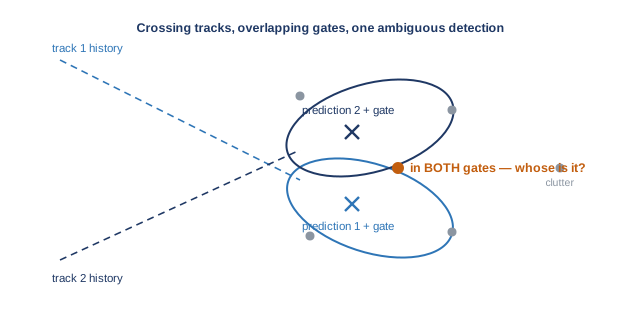
A tracker maintains, for each track, a prediction of where the next detection should appear and how uncertain that prediction is. The natural first filter is a validation gate: accept only detections that land close to the prediction, where "close" is measured not in meters but in units of the prediction's own uncertainty — the Mahalanobis distance. Each track, in effect, holds up a catcher's mitt whose size and shape are set by its uncertainty ellipse [1].
Gating disposes of most clutter cheaply. The trouble begins when mitts overlap: two tracks cross, their gates intersect, and one detection lands squarely inside both. Whose is it? Everything that follows is a different philosophy for answering.
GNN: decide once, decide globally, never look back
Global nearest neighbor treats the moment as an assignment problem: find the one-to-one pairing of tracks to detections that minimizes total statistical distance — solvable optimally by the Hungarian method or, distributed, by the auction algorithms this series met in the engagement context. GNN is fast, simple, and entirely adequate in sparse scenes. Its weakness is that every decision is hard and final: one wrong pairing at a crossing, and both tracks swap identities or one dies — an error the algorithm has no mechanism to revisit. In clutter, hard decisions accumulate hard mistakes.
JPDA: refuse to decide; hedge instead
Joint probabilistic data association declines to choose. It enumerates every feasible track-to-detection pairing, computes each pairing's probability, and updates every track with a probability-weighted blend of all detections in its gate [2]. No association is ever committed, so no single mistake is ever fatal — the hedge is the point. The costs are two. Computationally, the feasible-pairing enumeration grows quickly with scene density. Behaviorally, JPDA exhibits a documented artifact: two targets flying close and parallel share each other's detections in the blend, and their tracks drift together — coalescence — precisely the wrong failure mode when the close-flying pair is a threat and its decoy.
MHT: defer the decision until the future settles it
Multiple hypothesis tracking takes the most principled position: the ambiguous moment cannot be resolved now, so don't resolve it now [3]. Maintain every plausible association history as its own hypothesis, let each accumulate evidence over subsequent scans, and prune branches as the future reveals which past was true — a crossing that is ambiguous for one second is usually obvious three seconds later. Done exactly, this is the optimal Bayesian answer; done naively, it is intractable, because hypotheses multiply combinatorially:
Modern trackers therefore live on an engineering frontier: MHT-class deferred decisions where identity matters most, JPDA-class hedging where density is moderate, GNN where scenes are clean — often all three in one system, switched by measured scene complexity [1][4].
Why a defense architect should care
Association quality is upstream of everything this series has discussed. The engagement-assignment layer prices and allocates tracks; if two aircraft have swapped identities at a crossing, the assignment layer confidently sends an interceptor to the decoy and books the armed aircraft as handled. In the distributed setting the problem doubles: association must be solved not only between scans but between sensors — deciding that node A's track 7 and node B's track 12 are the same physical aircraft — under the bandwidth and correlation constraints of the fusion article. The open literature's lesson is not that one algorithm wins; it is that the choice is a load-bearing design decision with quantifiable trade-offs, and that a system's honesty about its association strategy under density is a fair proxy for its seriousness about the raid sizes that actually occur.
References
- Y. Bar-Shalom and X.-R. Li, Multitarget-Multisensor Tracking: Principles and Techniques, YBS Publishing, 1995.
- T. E. Fortmann, Y. Bar-Shalom, and M. Scheffe, "Sonar tracking of multiple targets using joint probabilistic data association," IEEE Journal of Oceanic Engineering, vol. 8, no. 3, 1983.
- D. B. Reid, "An algorithm for tracking multiple targets," IEEE Transactions on Automatic Control, vol. 24, no. 6, 1979.
- S. Blackman and R. Popoli, Design and Analysis of Modern Tracking Systems, Artech House, 1999.
This article synthesizes publicly available academic literature and public reporting. It describes concepts and results from the open published record and contains no Aerodyne technical data, system specifications, or performance information.
Working on coordination or counter-UAS problems?
Aerodyne AI builds mission-planning and coordination software for teams of uncrewed aircraft — and, with AeroVigil, fully passive drone detection for correctional facilities and critical infrastructure, including a limited number of no-cost 90-day pilot evaluations for qualifying facilities.