
Insights · Fusion & Distributed Intelligence
Fighting With a Compromised Network: Byzantine Resilience in Learning and Fusion
Every distributed defense network should be designed on one grim assumption: some of its nodes will eventually lie. A sensor is captured and spoofed; a relay is compromised; a software supply chain is poisoned. The question is not whether this happens but whether the collective computation — the shared model, the fused track picture — survives it. Forty years of theory says it can, gives the price in redundancy, and warns precisely which popular designs are fragile.
The generals, and the price of trust
The founding result is Lamport, Shostak, and Pease's Byzantine generals problem [1]: distributed parties must agree on a plan while some unknown subset sends arbitrary, even cleverly coordinated, lies. Their theorem is a budget line, not a metaphor:
The adjective "Byzantine" has since come to mean the worst failure class: not crashed nodes, not noisy nodes, but nodes behaving arbitrarily badly, possibly in collusion. Designing for it is what separates systems that assume a benign network from systems built for one that is under attack.
Why the average is infinitely fragile
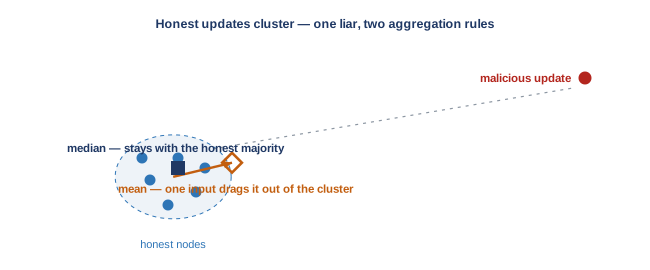
The modern battlefield version of the problem lives in distributed learning. In federated training — the architecture this series has advocated for exactly its data-custody virtues — nodes send model updates and a rule aggregates them. The natural rule, the mean, has a failure property worth stating baldly: a single malicious participant can move the average anywhere it likes, by sending an update large enough. One captured sensor node, one arbitrarily corrupted model. The robust-statistics repair is as old as the attack is obvious — aggregate with rules whose worst-case influence is bounded:
The theoretical literature has made this rigorous: gradient aggregation rules with convergence guarantees despite f Byzantine workers [2], and — the harder, more battlefield-relevant setting — fully decentralized variants with no trusted server at all, where resilience must hold peer-to-peer across a mesh [3]. The broader federated-learning survey literature treats Byzantine robustness as a first-class open problem rather than an afterthought [4], which is exactly the respect it deserves.
The fusion-layer twin: lying tracks
Everything above has a mirror image one layer down. A compromised node need not poison the model; it can poison the picture — injecting ghost tracks to draw interceptors, deleting real ones to open corridors, or subtly biasing its reported positions. The defensive repertoire rhymes with robust aggregation: cross-sensor consistency checking (a physical aircraft is corroborated across modalities and geometries; a fabricated one eventually is not), provenance-weighted fusion (influence proportional to a node's verifiable track record), and — the quiet contribution of consistent fusion rules — the structural property that no single input can collapse the fused uncertainty, which caps how much confidence a liar can manufacture.
Doctrine: bound influence by construction, not by detection
The unifying design lesson across both layers is a change of posture. Intrusion detection — spotting the compromised node — is valuable and inevitably incomplete; a sophisticated adversary lies just gently enough to evade the detector. The Byzantine literature's answer is structural: choose aggregation and fusion rules under which a bounded minority's influence is mathematically bounded regardless of whether it is ever identified. Then compromise degrades the network by a computable margin instead of capturing it outright — the same graceful-degradation philosophy this series has traced through communications loss and sensor attrition, extended to the harshest case, where the failed component is not silent but hostile. A network built this way makes the adversary's cheapest attack — capture one node, own the picture — simply not work, and forces them up the cost curve toward capturing a majority, which is no longer a hack; it is an assault.
References
- L. Lamport, R. Shostak, and M. Pease, "The Byzantine generals problem," ACM Transactions on Programming Languages and Systems, vol. 4, no. 3, 1982.
- P. Blanchard, E. M. El Mhamdi, R. Guerraoui, and J. Stainer, "Machine learning with adversaries: Byzantine tolerant gradient descent," Advances in Neural Information Processing Systems, 2017.
- Z. Yang and W. U. Bajwa, "ByRDiE: Byzantine-resilient distributed coordinate descent for decentralized learning," IEEE Transactions on Signal and Information Processing over Networks, vol. 5, no. 4, 2019.
- P. Kairouz et al., "Advances and open problems in federated learning," Foundations and Trends in Machine Learning, vol. 14, no. 1–2, 2021.
This article synthesizes publicly available academic literature and public reporting. It describes concepts and results from the open published record and contains no Aerodyne technical data, system specifications, or performance information.
Working on coordination or counter-UAS problems?
Aerodyne AI builds mission-planning and coordination software for teams of uncrewed aircraft — and, with AeroVigil, fully passive drone detection for correctional facilities and critical infrastructure, including a limited number of no-cost 90-day pilot evaluations for qualifying facilities.